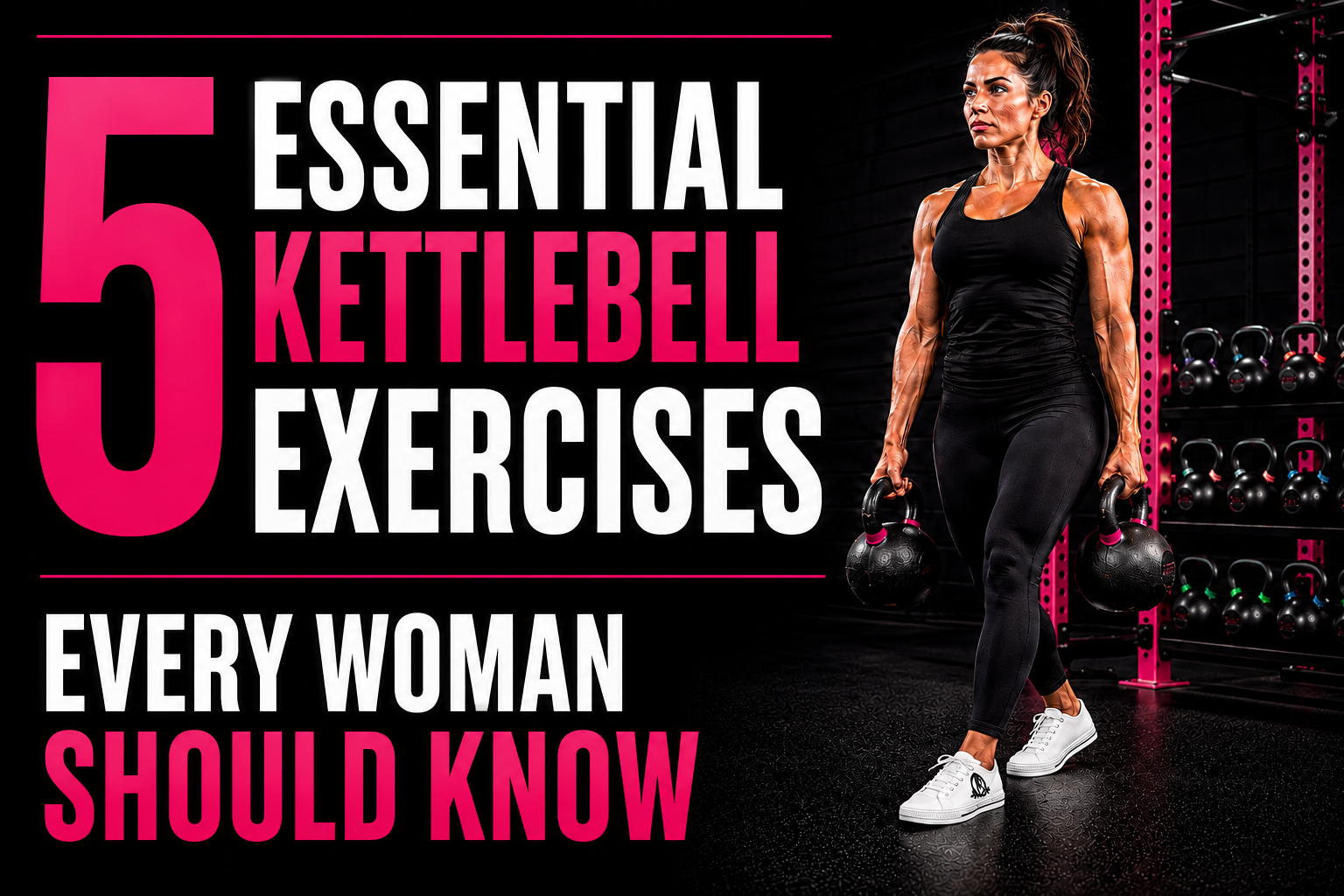
THE PROBLEM WITH KETTLEBELLS? Most women don’t know what to do with them. Let’s Change That…
The Problem With Kettlebells?
Most women don’t know what to do with them.
Let’s change that…
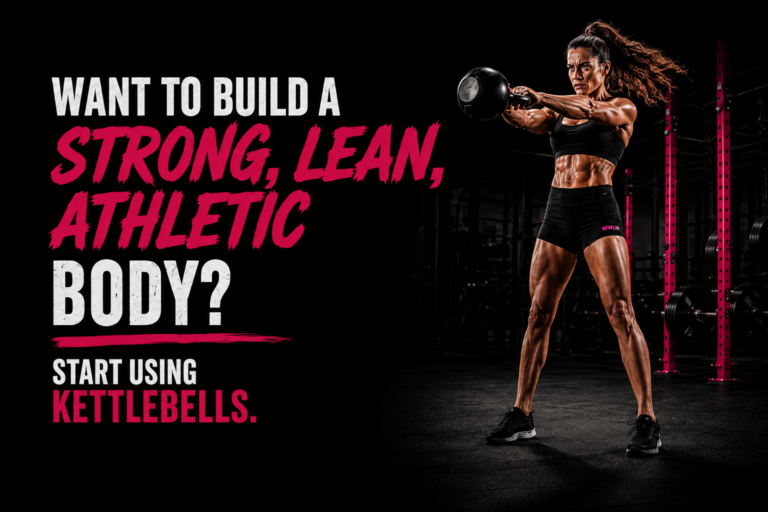
Kettlebells are not just dumbbells with different handles.
And kettlebell training isn’t typically about walking into the gym and saying, “Today I’m training biceps,” or “Today is shoulders.” Kettlebells are different. They’re designed to train your body through movement.
Movements first. Muscles second.
That’s also why there’s a little more of a learning curve when you first start using them. You need to learn the fundamentals:
The Foundations
- ✓
Squat
- ✓
Deadlift / Hinge
- ✓
Swing
- ✓
Row
- ✓
Press
- ✓
Carry
Build those foundations first. From there, you can progress into movements like cleans, high pulls, and snatches, along with different variations, pairings, and eventually full kettlebell complexes.
And that’s when you begin to realize just how versatile one or two kettlebells can be. You can use kettlebells to build strength, build muscle, improve conditioning, develop power, improve coordination, burn calories, and train your entire body.
But don’t make the mistake of trying to learn everything at once.
Start with the basics. Build your foundation. Progress from there.
Goblet Squat
The goblet squat is where most kettlebell training starts — and for good reason. Holding the weight in front of your chest naturally counterbalances your body, which makes it easier to sit down into a deep, controlled squat than almost any other loaded squat variation.
That counterbalance isn’t just a beginner-friendly shortcut, though. It teaches your body what a good squat actually feels like — chest up, knees tracking over your toes, weight through your heels — before you ever add a barbell or move to more complex kettlebell work.
How To Do It
Hold the kettlebell by the horns at chest height, feet roughly shoulder-width apart. Sit your hips back and down, keeping your chest tall and elbows tucked close to your ribs. Descend until your elbows brush the inside of your knees, then drive through your heels to stand back up.
Focus
Quads, glutes, core, and squat mechanics.
Benefits
Builds lower-body strength while reinforcing proper squat depth and posture — the same pattern you’ll rely on in nearly every other kettlebell movement.
Common Mistake
Letting the chest collapse forward as you descend. Once your torso tips over, the kettlebell pulls you further out of position and your knees usually cave in to compensate. Keep your chest proud through the entire movement — if you can’t, the weight is too heavy or the depth is too much for right now.
💡 Coach’s Tip
Use your elbows as a guide. When they touch the inside of your knees, you’ve hit a solid depth — you don’t need to force it any deeper than that to get the benefit.
Want A Complete Training Program?
Take the guesswork out of your training. Our Training Guides go beyond a single program — barbell, dumbbell, and kettlebell guides and programs, all designed to build real strength and results.
Shop Training GuidesKettlebell Deadlift / Hinge
If the goblet squat teaches you to sit down, the deadlift teaches you to bend at the right joint — your hips, not your spine. This is the hinge pattern, and it’s arguably the single most important movement you’ll learn with a kettlebell, because it’s the foundation of the swing, the clean, and nearly every explosive kettlebell movement that follows.
A lot of women arrive here already unconsciously good at squatting but rounding their back the moment they try to pick something up off the floor. The kettlebell deadlift retrains that pattern with a light, forgiving load before you ever need to hinge under something heavier.
How To Do It
Stand with the kettlebell a few inches in front of your feet. Push your hips back while keeping your shins mostly vertical and your back flat, reaching down to grip the handle. Drive your hips forward to stand tall, squeezing your glutes at the top.
Focus
Glutes, hamstrings, and lower back.
Benefits
Builds the hip hinge pattern that underlies nearly every powerful kettlebell movement, while strengthening your entire posterior chain in the process.
Common Mistake
Squatting the weight up instead of hinging. If your knees are traveling far forward and your hips are dropping straight down, you’ve turned a hinge into a squat. Keep the movement at your hips — think about pushing them back toward a wall behind you, not sitting down.
💡 Coach’s Tip
Keep the kettlebell close to your shins on the way down. The further it drifts away from your body, the more strain gets placed on your lower back instead of your glutes and hamstrings.
Two Variations To Try
Alternating Hand Deadlift
Gladiator Deadlift
Kettlebell Swing
The swing is where the hinge you just learned stops being a slow, controlled pattern and becomes explosive. It’s the movement most people picture when they think of kettlebell training — and it’s usually the reason women get frustrated early on, because it looks simple but is genuinely one of the harder patterns to get right.
The swing isn’t an arm exercise, even though it can feel that way at first. The kettlebell should never be lifted — it should be projected forward and up by an aggressive hip drive, the same hip snap you built in the deadlift, just done with speed and intent.
How To Do It
Hinge at your hips and let the kettlebell swing back between your legs. Explosively drive your hips forward, using that power to project the kettlebell up to chest height. Let it float for a moment, then let gravity bring it back down into the next hinge.
Focus
Glutes, hamstrings, core, and explosive hip power.
Benefits
Builds explosive power and conditioning at the same time — a rare combination that makes the swing one of the most efficient exercises in kettlebell training.
Common Mistake
Squatting the swing instead of hinging it, or trying to muscle the kettlebell up with your arms and shoulders. If your arms feel like they’re doing the lifting, the power isn’t coming from your hips yet — slow down, hinge deeper, and focus on the snap.
💡 Coach’s Tip
Think “hike, drive, float.” Hike the kettlebell back like a football snap, drive your hips forward hard, and let the kettlebell float weightless at the top before it falls back into the next rep.
Gear Up For Your Next Workout
Programs, clothing, merchandise, and more — the WWLW Store has everything you need to train hard and represent the community that’s building strength together.
Shop The StoreKettlebell Press
The kettlebell press looks like a simple overhead press, but the offset weight of a kettlebell makes it a different challenge entirely. Because the bell sits behind your wrist rather than balanced directly above it, your shoulder and core have to work harder just to keep everything stable — long before you even start pressing.
That instability is a feature, not a flaw. It’s what makes the kettlebell press such an effective way to build real shoulder stability, not just shoulder strength.
How To Do It
Clean the kettlebell to your shoulder, with the bell resting against the back of your forearm. Brace your core, then press the kettlebell straight overhead until your arm is fully locked out. Lower it back down to your shoulder with control.
Focus
Shoulders, triceps, and core.
Benefits
Builds strong, stable shoulders and teaches full-body tension — your core and glutes have to stay braced to support the weight moving overhead.
Common Mistake
Letting the ribs flare and the lower back arch as the weight goes overhead. If you find yourself leaning back to “help” the kettlebell up, your core has disengaged. Keep your ribs pulled down and your glutes squeezed throughout the entire press.
💡 Coach’s Tip
Press in a slight arc, not a straight vertical line. Punch slightly out and around your head rather than trying to push straight up through it — this keeps the bell path smooth and your shoulder in a safer position.
Kettlebell Row
The row is your pulling counterpart to the press — and it’s just as important, even though it tends to get far less attention. A strong row builds the back strength that keeps your shoulders healthy and your posture upright, especially if you spend most of your day sitting.
Once you’ve got the basic row down, it opens the door to more dynamic variations that build power and grip strength on top of pure back strength — which is exactly what the video below demonstrates.
How To Do It
Hinge at your hips with a flat back, kettlebell hanging in one hand. Pull the kettlebell up toward your hip, keeping your elbow close to your body, then lower it back down with control.
Focus
Back, biceps, and grip.
Benefits
Builds upper-back strength and improves posture — a direct counterbalance to all the pressing and forward-leaning movement most of us do throughout the day.
Common Mistake
Rotating the torso to help muscle the weight up instead of keeping the hips and shoulders square to the floor. If your body is twisting, the weight is too heavy or you’re pulling with your arm alone instead of your back.
💡 Coach’s Tip
Think about pulling your elbow toward the ceiling, not just lifting the kettlebell. That cue naturally engages your back muscles instead of letting your bicep do all the work.
Shown: Kettlebell Ballistic Row — a more advanced row variation
Kettlebell Carry
The carry is the simplest movement on this list, and it’s easy to dismiss for exactly that reason. Pick up a kettlebell, walk. But simple doesn’t mean unimportant — the carry ties together everything you’ve built so far, forcing your grip, core, and posture to hold up under real load while you’re actually moving.
It’s also the closest thing on this list to real life. Groceries, luggage, a laundry basket, a toddler — carries build the exact kind of strength that shows up outside the gym, which is part of why it’s such a satisfying movement to train.
How To Do It
Pick up a kettlebell in one hand (or one in each hand), stand tall, and walk for a set distance or time while keeping your shoulders back and core braced. Switch sides if carrying single-arm.
Focus
Grip, core, and total-body stability.
Benefits
Builds functional, real-world strength — grip endurance, core stability, and posture under load — with almost zero technical barrier to entry.
Common Mistake
Letting the weighted side pull your torso into a lean. If you’re carrying single-arm and your shoulders start tilting toward the kettlebell, your core has stopped doing its job. Stay tall and resist the pull — that resistance is the whole point of the exercise.
💡 Coach’s Tip
Don’t rush it. Walking slightly slower than feels natural forces your core and grip to work harder for longer — this isn’t a race, it’s a tension exercise disguised as a walk.
The 6 Movements That Solve The Kettlebell Problem
- 1
Goblet Squat
- 2
Deadlift / Hinge
- 3
Swing
- 4
Row
- 5
Press
- 6
Carry
This is the problem with kettlebells solved — not by learning a hundred exercises, but by learning six movements well. Every advanced variation, every complex, every clean and snatch you’ll eventually work toward is built on top of this same foundation.
Master these first. Everything else with a kettlebell gets easier from here.
Movements First. Muscles Second.