5 Dumbbell Exercises Every Woman Should Know
You Don’t Need Hundreds of Exercises to Get Strong
One of the biggest mistakes I see women make is constantly searching for the next “best” exercise.
Every week there’s a new workout, a new challenge, or a new exercise trending on social media. Before long, workouts become a collection of random movements instead of a structured strength training program.
The truth is, building strength doesn’t require dozens of different exercises.
If your goal is to build muscle, become stronger, improve confidence, and move better in everyday life, you can accomplish an incredible amount with just a handful of well-chosen movements.
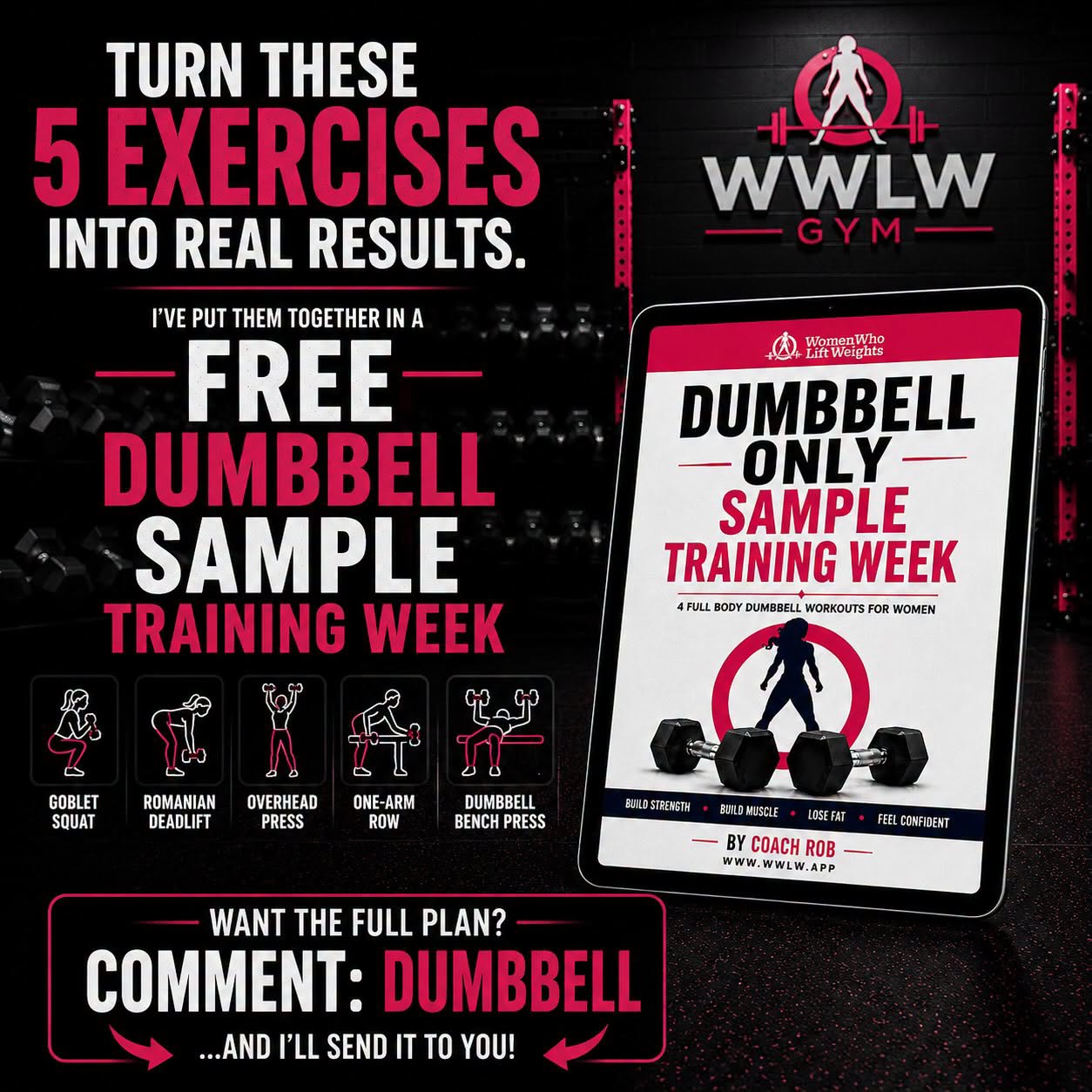
If I had to narrow it down, these are the five dumbbell exercises I believe every woman should learn first.
Together they train nearly every major muscle group in your body while teaching movement patterns you’ll continue using for years. Whether you’re brand new to lifting weights or you’ve been training for a while, mastering these five exercises will build a foundation that makes every future workout more productive.
Rather than constantly chasing variety, focus on becoming stronger at the basics. Learn proper technique, gradually increase the weight over time, and stay consistent.
You’ll be surprised how far these five exercises can take you. They aren’t flashy, but they work — and they’ve helped thousands of women build stronger, healthier bodies.
Let’s take a closer look at each exercise, why it deserves a place in your program, how to perform it correctly, and a few common mistakes to avoid.
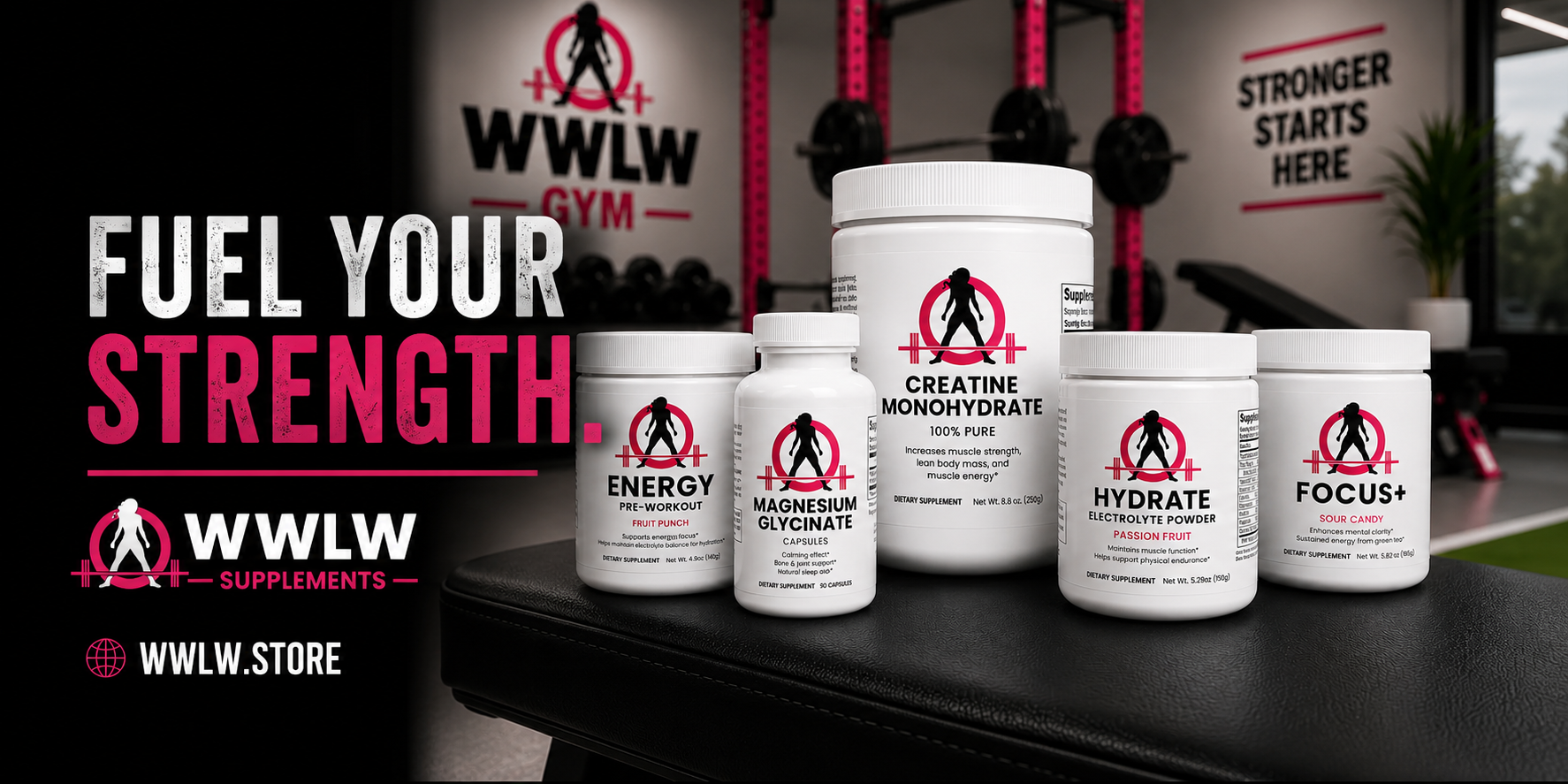
Click the image to shop WWLW Supplements.
Goblet Squat
If I could teach every woman just one lower-body exercise, the Goblet Squat would be near the top of the list. It’s one of the safest, most effective ways to build lower-body strength while learning proper squat technique.
Holding a dumbbell in front of your chest naturally encourages good posture, helps you stay upright, and makes it easier to learn how to squat correctly. Whether you’re lifting at home or in the gym, the Goblet Squat is an exercise you’ll continue benefiting from for years.
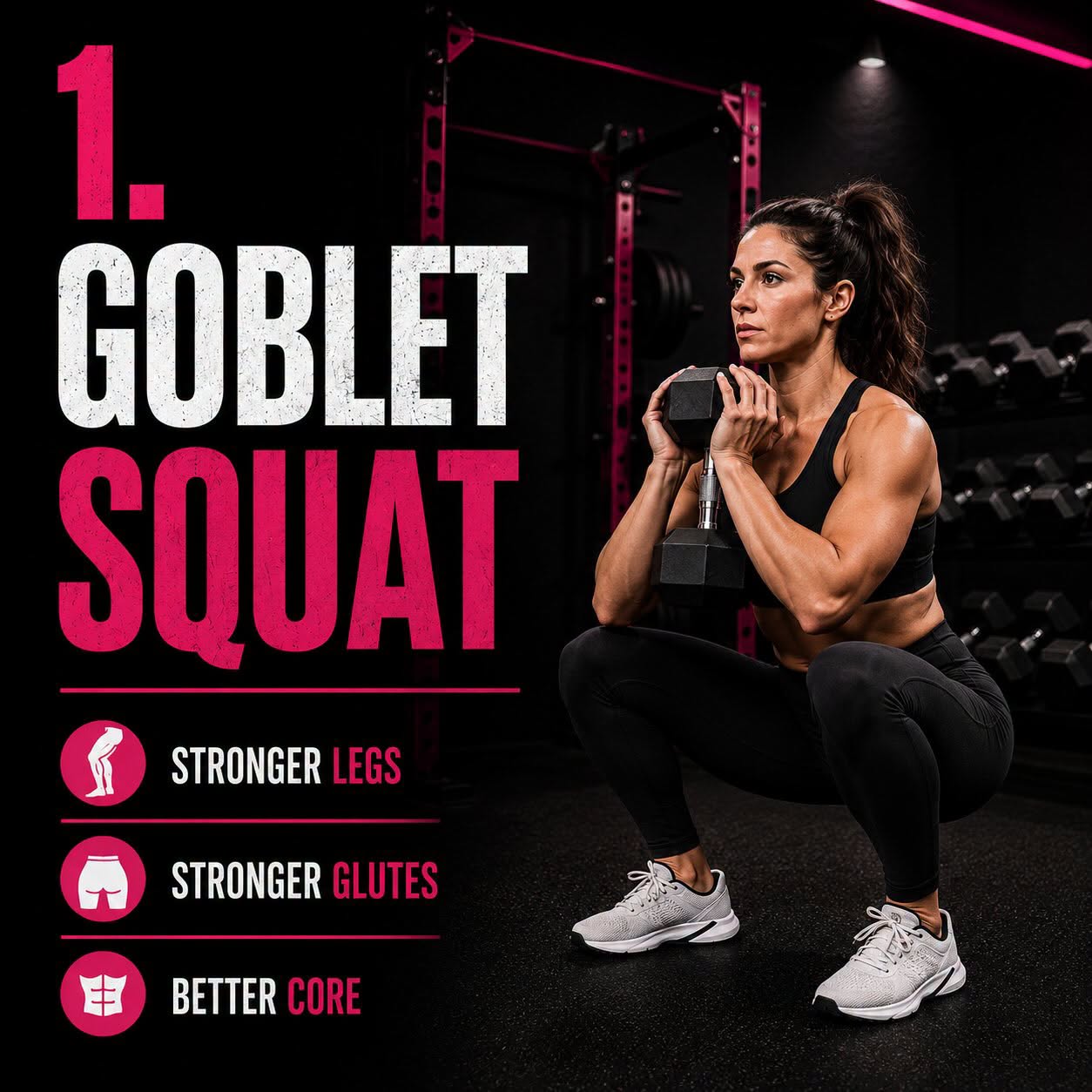
What Muscles Does the Goblet Squat Work?
The Goblet Squat is a full-body compound exercise that primarily targets your:
- Quadriceps (front of the thighs)
- Glutes
- Hamstrings
- Core
- Upper back
Because the dumbbell is held in front of your body, your core and upper back work hard to keep your torso upright throughout the movement. This makes the Goblet Squat an excellent exercise for developing strength, stability, and proper squat mechanics.
How to Perform the Goblet Squat
- Hold one dumbbell vertically against your chest with both hands.
- Stand with your feet approximately shoulder-width apart and your toes turned slightly outward.
- Brace your core and keep your chest tall.
- Begin the movement by pushing your hips back while bending your knees.
- Lower until your thighs are about parallel to the floor, or as deep as your mobility allows while maintaining good technique.
- Drive through your feet and stand back up until your hips and knees are fully extended.
- Repeat for the desired number of repetitions.
Common Mistakes
- Allowing the knees to collapse inward.
- Rounding the lower back.
- Letting the heels lift off the floor.
- Looking down instead of keeping your chest proud.
- Using more weight than you can control with proper technique.
Coach Rob’s Tip
One of the biggest mistakes I see is women trying to squat as low as possible while sacrificing good technique. Don’t worry about how deep you can go only. Focus on keeping your chest tall, your core braced, and moving through a pain-free range of motion. As your strength and mobility improve, your squat depth will improve naturally.
Watch the Exercise Demonstration
Watch the complete Goblet Squat demonstration below to see proper technique, body positioning, and coaching cues.
Romanian Deadlift
If the Goblet Squat teaches you to squat, the Romanian Deadlift teaches you to hinge — and if you only ever learn one lower-body pattern besides the squat, make it this one. It’s the movement that builds a strong, resilient posterior chain and protects your lower back for everything else you do, in and out of the gym.
A lot of women avoid deadlifts because they sound intimidating. They’re not. The Romanian Deadlift is simply about learning to bend at your hips instead of your spine — a skill that carries over to picking up groceries, kids, and everything in between.
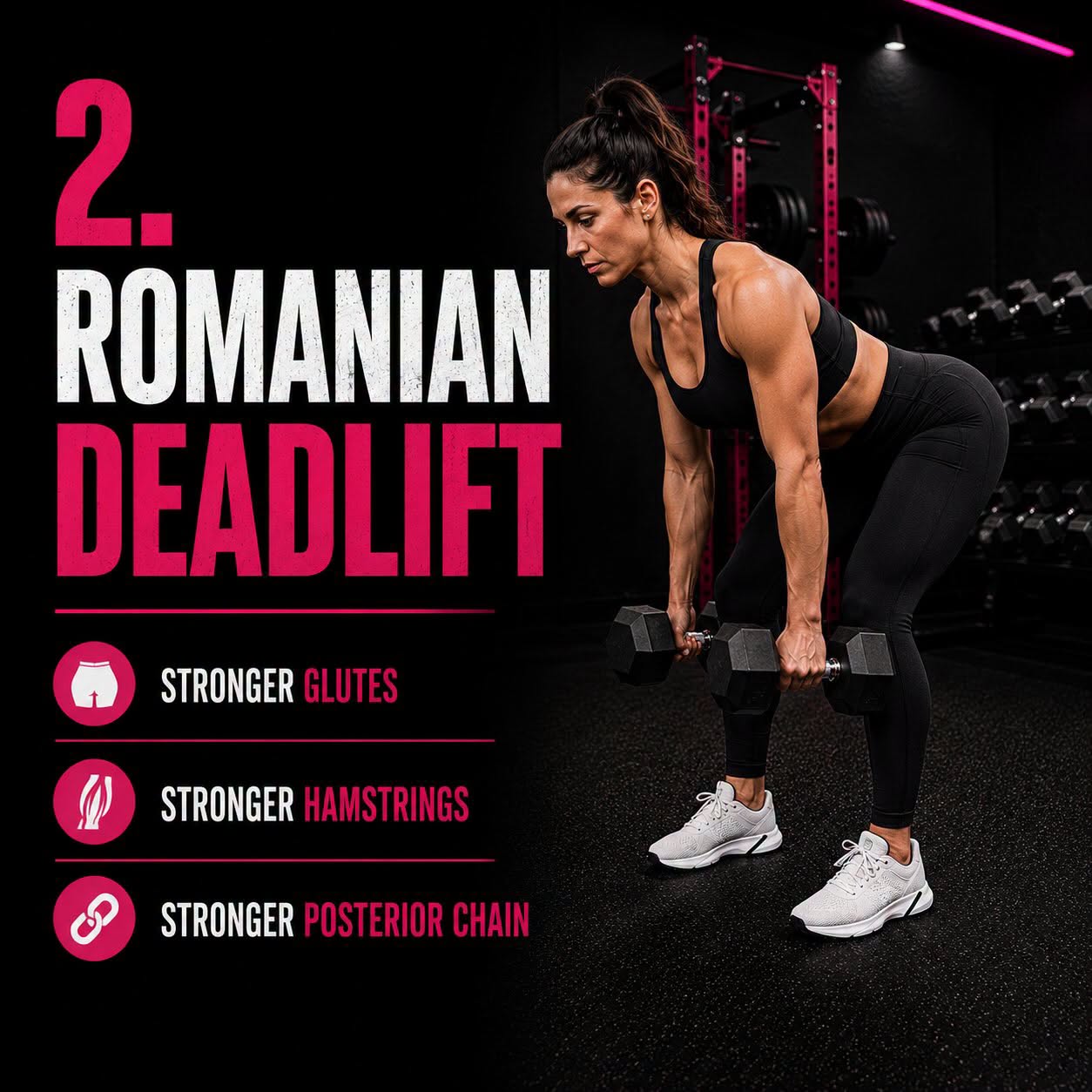
What Muscles Does the Romanian Deadlift Work?
The Romanian Deadlift is a hip-hinge movement that primarily targets your:
- Hamstrings
- Glutes
- Lower back (erectors)
- Core
- Grip & forearms
Unlike a squat, which bends primarily at the knees, the RDL bends primarily at the hips with a soft knee bend. That hip-hinge pattern is exactly why it builds so much strength through your hamstrings and glutes — and why it’s one of the best exercises for building a strong, stable lower back.
How to Perform the Romanian Deadlift
- Hold a dumbbell in each hand in front of your thighs, palms facing your body.
- Stand with your feet hip-width apart and a slight bend in your knees.
- Brace your core and keep your chest tall.
- Push your hips back while lowering the dumbbells down the front of your legs, keeping them close to your body.
- Lower until you feel a stretch through your hamstrings — typically around mid-shin to just below the knee.
- Drive your hips forward to return to standing, squeezing your glutes at the top.
- Repeat for the desired number of repetitions.
Common Mistakes
- Rounding the lower back instead of hinging with a flat spine.
- Bending the knees too much and turning it into a squat.
- Letting the dumbbells drift away from the body.
- Hyperextending the lower back at the top of the movement.
- Going lower than your hamstring flexibility allows.
Coach Rob’s Tip
The biggest fix I give women on this lift is simple: stop thinking about how low you can go, and start thinking about how far back you can push your hips. If your lower back rounds before your hamstrings feel stretched, that’s your true range of motion for now — not the floor. Depth will come with time. Technique comes first.
Watch the Exercise Demonstration
Watch the complete Romanian Deadlift demonstration below to see proper technique, body positioning, and coaching cues.
Overhead Press
The Overhead Press is the one movement on this list that trains true upper-body pushing strength from a standing position — no bench, no machine, just you and the dumbbells fighting gravity straight overhead. It builds strong shoulders, a stable core, and the kind of pressing power that carries over to everything from loading a shelf to a barbell push press.
A lot of women skip overhead pressing because it feels harder to control than a bench press. That’s actually the point — standing overhead work forces your whole body to stabilize, not just your shoulders, which is exactly why it belongs in a full-body strength program.
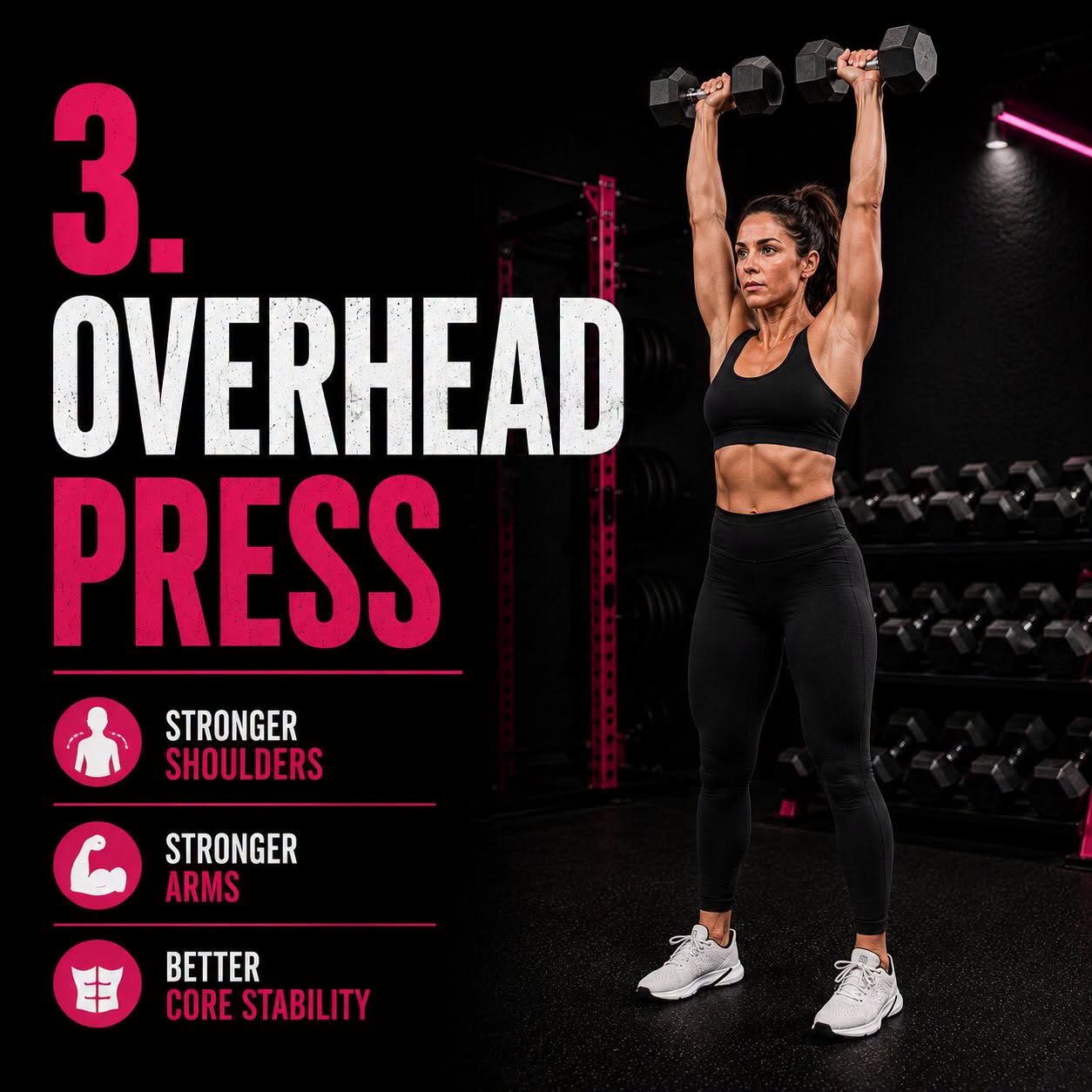
What Muscles Does the Overhead Press Work?
The Overhead Press is a standing compound push that primarily targets your:
- Shoulders (deltoids)
- Triceps
- Upper chest
- Core
- Glutes (from bracing and stabilizing)
Because you’re pressing overhead from a standing position with no back support, your core and glutes have to work hard just to keep you upright and stable. That’s what makes the Overhead Press so much more than a “shoulder exercise” — it’s a full-body strength builder disguised as an upper-body movement.
How to Perform the Overhead Press
- Hold a dumbbell in each hand at shoulder height, palms facing forward.
- Stand with your feet hip-width apart and brace your core.
- Squeeze your glutes slightly to keep your ribs stacked over your hips.
- Press the dumbbells straight overhead until your arms are fully extended.
- Avoid arching your lower back as you press — keep your core braced throughout.
- Lower the dumbbells back to shoulder height with control.
- Repeat for the desired number of repetitions.
Common Mistakes
- Arching the lower back to push the weight up.
- Pressing the dumbbells forward instead of straight overhead.
- Flaring the ribs and losing core brace at the top.
- Using leg drive to “cheat” the weight up.
- Choosing a weight so heavy that form breaks down.
Coach Rob’s Tip
Before you worry about how much weight you’re pressing, worry about your ribcage. If your ribs are flaring up and your lower back is arching as you press, that’s your core losing the brace — and that’s where overhead pressing goes wrong for most women. Keep your ribs stacked over your hips like you’re bracing for a punch to the stomach, and the weight on the bar will take care of itself over time.
One-Arm Row
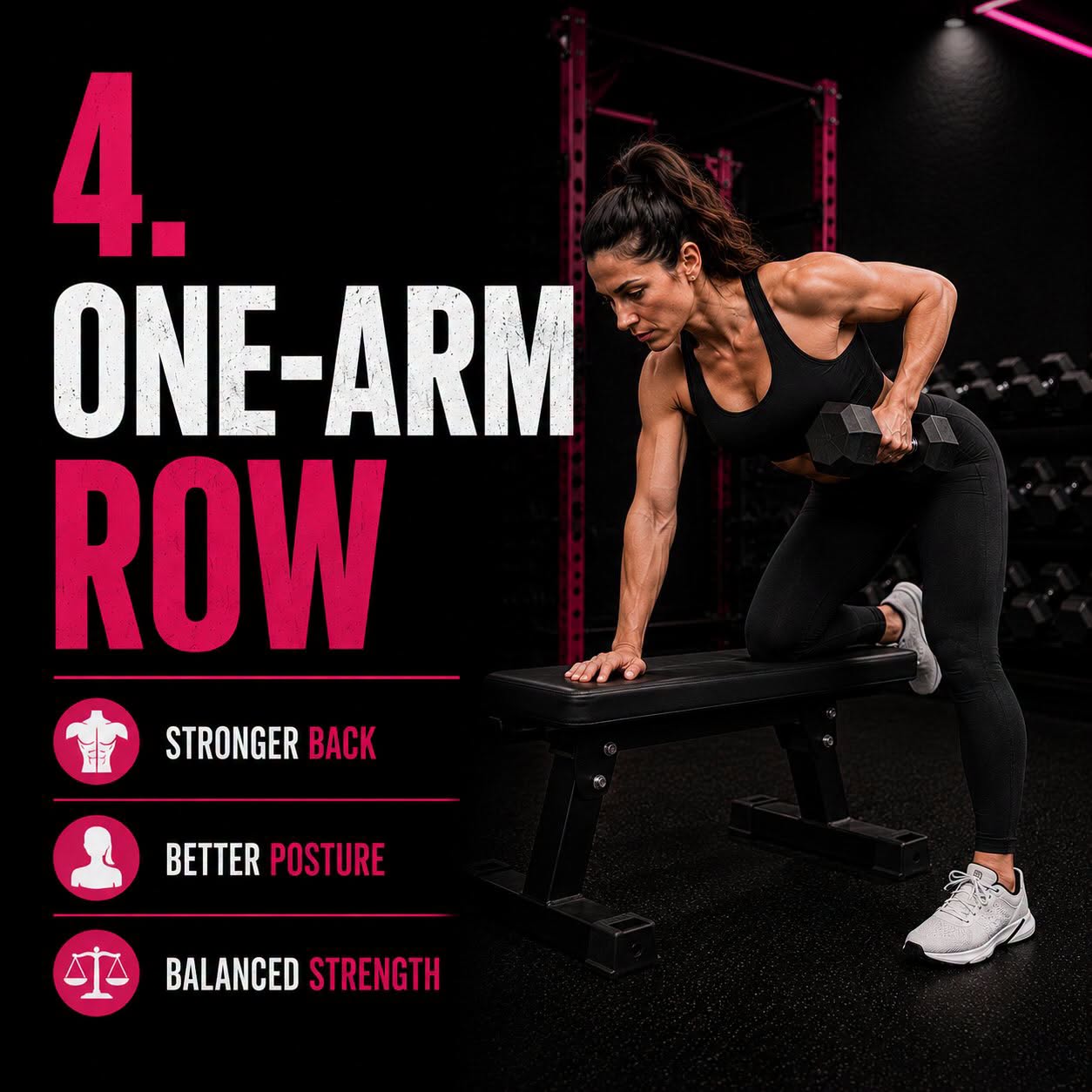
Every strength program needs a pulling movement to balance out all the pushing, and the One-Arm Row is one of the most effective ways to build a strong, well-developed back with nothing but a single dumbbell and a bench. It’s also one of the few exercises on this list that trains each side of your body independently — which matters more than most women realize.
Training unilaterally, one arm at a time, forces each side of your back to work equally hard. No dominant side sneaking in to do extra work, no imbalances quietly building up over time. Just a stronger, more balanced upper body.
What Muscles Does the One-Arm Row Work?
The One-Arm Row is a unilateral pulling movement that primarily targets your:
- Lats (upper back)
- Rhomboids & mid-back
- Biceps
- Rear delts
- Core (anti-rotation)
Because you’re supporting yourself with one hand on a bench while rowing with the other, your core has to resist rotation the entire time. That anti-rotation demand is what makes the One-Arm Row just as much a core exercise as it is a back exercise.
How to Perform the One-Arm Row
- Place one knee and one hand on a bench, with your back flat and parallel to the floor.
- Hold a dumbbell in your free hand, arm fully extended toward the floor.
- Brace your core and keep your spine neutral — avoid letting your torso rotate.
- Pull the dumbbell up toward your hip, leading with your elbow.
- Squeeze your shoulder blade at the top of the movement.
- Lower the dumbbell back down with control until your arm is fully extended.
- Complete all reps on one side before switching to the other.
Common Mistakes
- Rotating the torso to help lift the weight.
- Rounding the lower back instead of staying flat.
- Using momentum instead of a controlled pull.
- Shrugging the shoulder up toward the ear instead of pulling with the back.
- Not fully extending the arm at the bottom of each rep.
Coach Rob’s Tip
Watch your torso, not just your arm. If your hips or shoulders are twisting every time you row the weight up, that’s momentum doing the work your back should be doing. Slow it down, keep your torso still, and lead the pull with your elbow instead of your hand. A controlled row with a lighter dumbbell will build more back strength than a heavy one done with a twist.
Watch the Exercise Demonstration
Watch the complete One-Arm Row demonstration below to see proper technique, body positioning, and coaching cues.
Dumbbell Bench Press
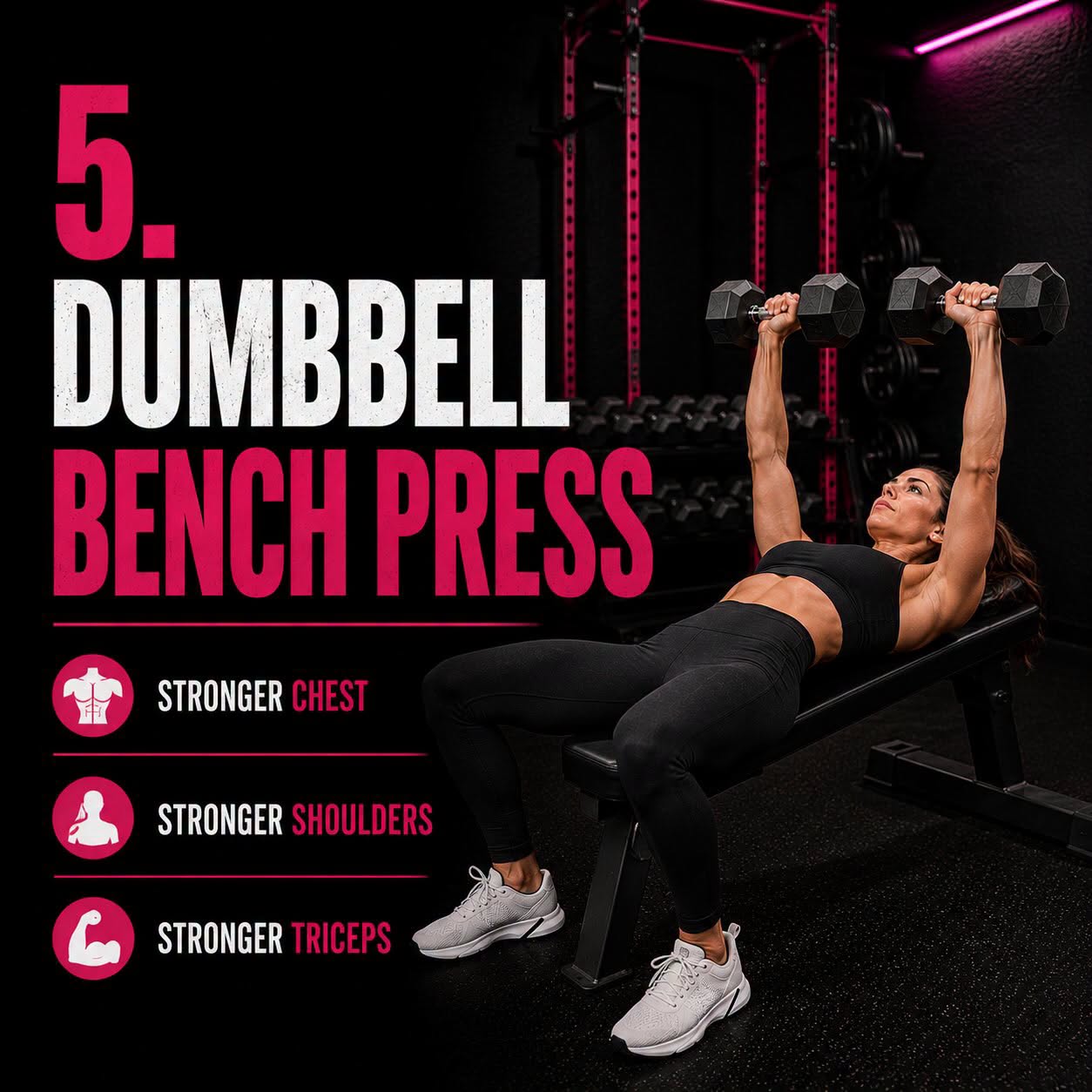
Rounding out this list is the Dumbbell Bench Press — the movement most women already know by name, but not always by proper technique. It’s one of the best exercises for building real upper-body pushing strength, and using dumbbells instead of a barbell gives you a few advantages most women never get told about.
Because each arm has to press independently, dumbbells expose and fix strength imbalances a barbell can hide. They also allow a greater, more natural range of motion through your shoulders — which often means less shoulder discomfort, not more.
What Muscles Does the Dumbbell Bench Press Work?
The Dumbbell Bench Press is a horizontal push that primarily targets your:
- Chest
- Shoulders (front deltoids)
- Triceps
- Core (stabilization)
Since you’re controlling two independent weights instead of one fixed barbell, your stabilizer muscles — including your core and shoulder stabilizers — have to work harder throughout the entire lift. That’s why dumbbells often build more well-rounded pressing strength than a barbell alone.
How to Perform the Dumbbell Bench Press
- Lie flat on a bench holding a dumbbell in each hand at chest level, palms facing your feet.
- Plant your feet firmly on the floor and keep your shoulder blades pulled back and down.
- Brace your core and press the dumbbells straight up until your arms are fully extended.
- Avoid letting the dumbbells drift too far forward or knock together at the top.
- Lower the dumbbells with control back to chest level, keeping your elbows at roughly a 45-degree angle from your body.
- Repeat for the desired number of repetitions.
Common Mistakes
- Flaring the elbows straight out to the sides.
- Bouncing the dumbbells off the chest at the bottom.
- Letting the shoulder blades lift off the bench.
- Pressing the dumbbells unevenly, one arm leading the other.
- Losing control on the way down instead of lowering with tension.
Coach Rob’s Tip
Keep your shoulder blades pinned to the bench the entire set — that’s the cue most women are missing. If your shoulders roll forward as you press, your chest stops doing the work and your shoulders take over, which is exactly how this exercise starts to feel uncomfortable instead of strong. Set your shoulder blades back and down before your first rep, and keep them there until your last.
Watch the Exercise Demonstration
Watch the complete Dumbbell Bench Press demonstration below to see proper technique, body positioning, and coaching cues.
Five Movements. A Lifetime of Progress.
That’s the list. Not fifty exercises, not a new “trend” every week — just five dumbbell movements that, done consistently and with good technique, will build more real strength than chasing variety ever will.
Squat. Hinge. Push overhead. Pull. Press horizontally. Between those five patterns, you’ve covered nearly every major muscle group in your body — and you have a foundation you can keep building on for years, simply by adding weight and improving your technique over time.
Master these five before you go looking for more. The basics, done consistently, are what actually build strength.