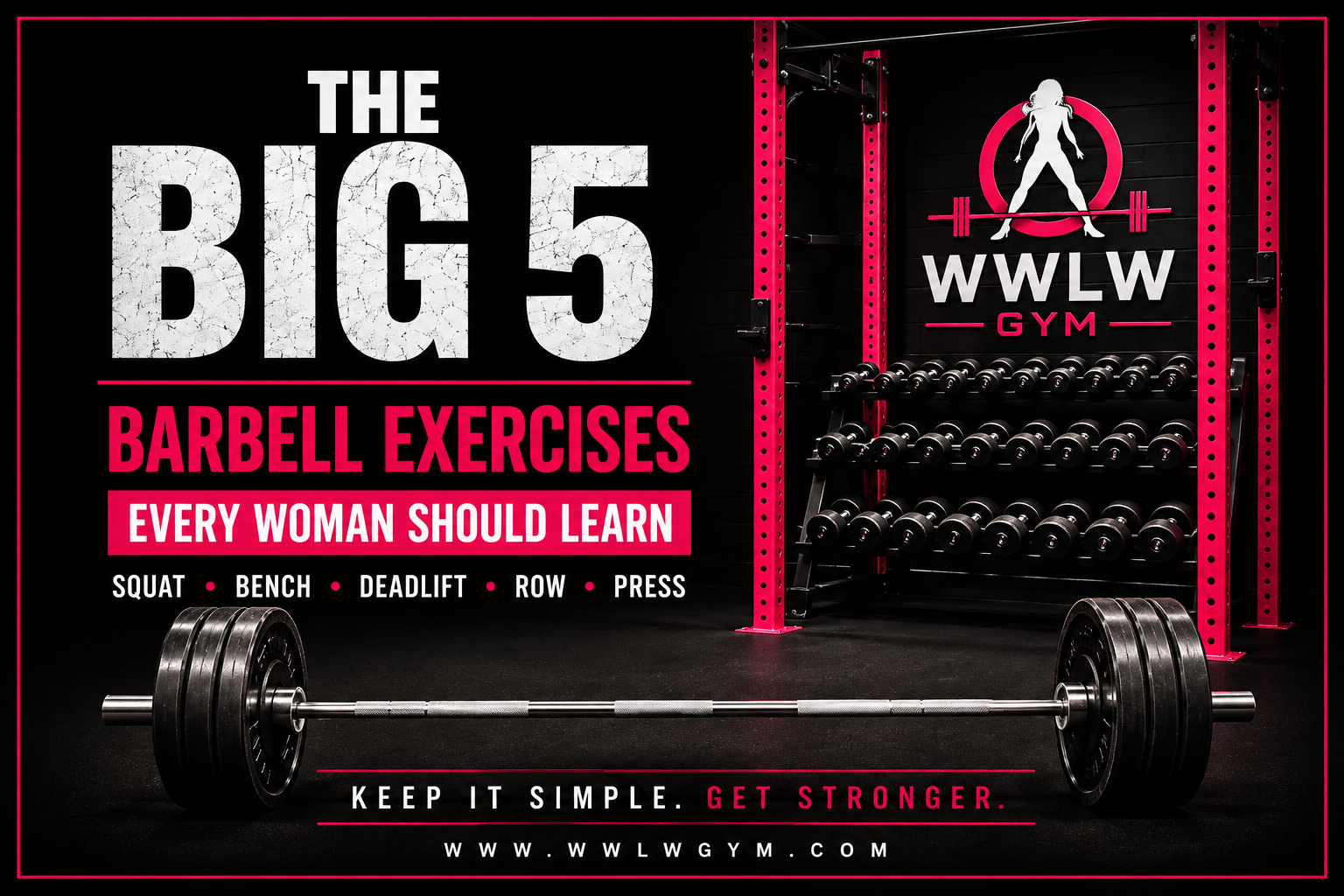
The Big 5 Barbell Exercises Every Woman Should Learn
If your goal is to build strength, muscle, confidence, and overall fitness with a barbell, these are the five exercises I recommend learning first.
Not fifty exercises. Not a new movement every week. Five. That’s it — and if you master these, you’ll have a stronger foundation than most people ever build in years of random training.
The barbell has a reputation for being intimidating, but it’s actually one of the simplest tools out there once you understand what it’s for. It doesn’t need a hundred variations to be effective. It needs you to show up, learn a handful of movements properly, and keep adding weight over time.
You don’t need dozens of complicated exercises to make incredible progress — you need a strong foundation and consistency.
These five movements are the foundation of almost every great strength program. Master them first, focus on good technique, and keep adding weight over time. Everything else you build in the gym stands on top of what these five teach you.
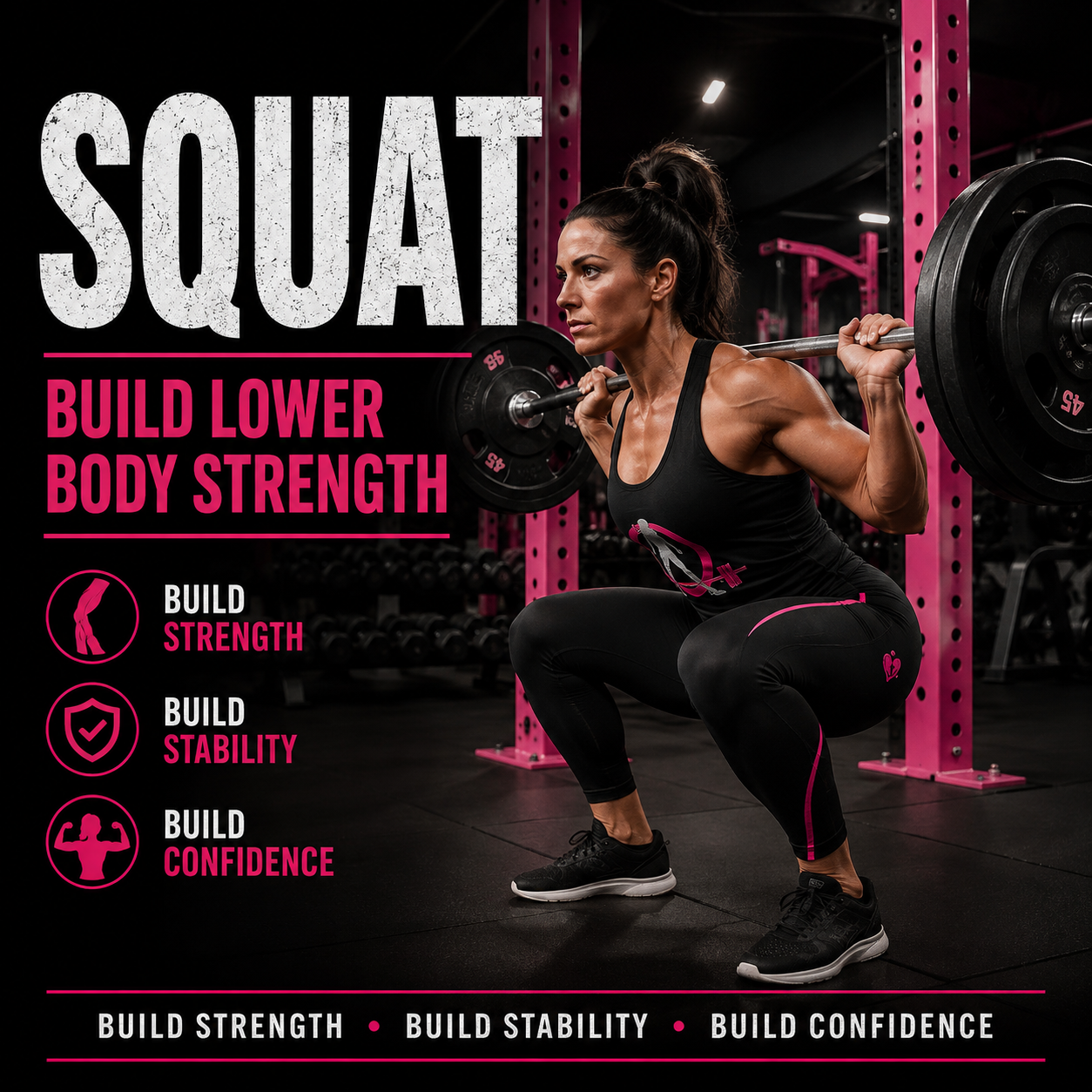
Barbell Squat
If there’s one exercise that belongs at the top of every strength program, it’s the squat. It builds serious lower-body strength, improves stability, and develops powerful legs and glutes — all while training your body to move the way it’s meant to move.
A lot of women avoid the barbell squat because it looks intimidating loaded on a rack. In reality, it’s simply a bodyweight squat with a bar on your back — the technique is the same, the demand is just higher, and the payoff is bigger.
What Muscles Does the Barbell Squat Work?
The Barbell Squat is a full-body compound movement that primarily targets your:
- Quadriceps
- Glutes
- Hamstrings
- Core
- Upper & lower back
Because the bar loads your entire spine, your core and back have to stay braced and stable through the whole movement. That’s why the squat builds so much more than leg strength — it teaches your entire body to work together under load.
How to Perform the Barbell Squat
- Set the bar on your upper back (not your neck), resting across your trapezius muscles.
- Stand with your feet shoulder-width apart, toes turned slightly outward.
- Brace your core and keep your chest tall.
- Push your hips back and bend your knees to lower into the squat.
- Descend until your hips are at or below parallel, keeping your knees tracking over your toes.
- Drive through your feet to stand back up, keeping your chest up and core braced throughout.
- Repeat for the desired number of repetitions.
Common Mistakes
- Letting the knees collapse inward.
- Rounding the lower back at the bottom of the squat.
- Rising onto the toes instead of driving through the whole foot.
- Not squatting deep enough to properly load the hips and glutes.
- Using more weight than can be controlled with good technique.
Coach Rob’s Tip
Before you worry about how much weight is on the bar, worry about your depth and your brace. A controlled squat to proper depth with a lighter bar builds more real strength than a heavy, half-rep squat ever will. Get the technique right first — the weight will come.
Watch the Exercise Demonstration
Watch the complete Barbell Squat demonstration below to see proper technique, body positioning, and coaching cues.
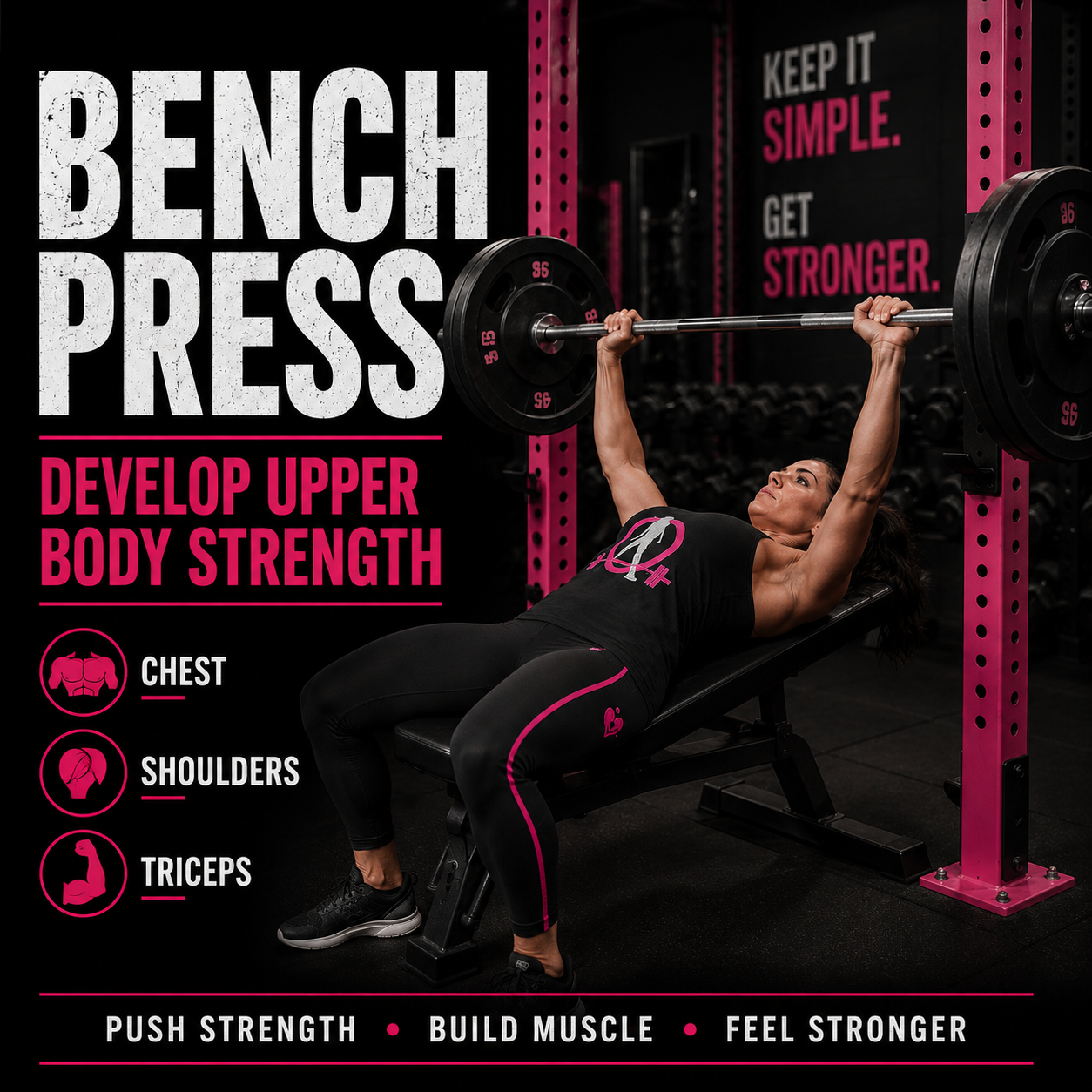
Barbell Bench Press
The Bench Press is the classic upper-body strength builder — and for good reason. It develops real pressing power through your chest, shoulders, and triceps, and it’s one of the clearest ways to track upper-body strength over time.
Unlike dumbbells, the barbell forces both arms to work together through a fixed, stable path. That stability lets you load more weight and build raw pressing strength more efficiently than almost any other upper-body movement.
What Muscles Does the Bench Press Work?
The Barbell Bench Press is a horizontal push that primarily targets your:
- Chest
- Shoulders
- Triceps
Your shoulders and triceps assist through the whole range of motion, but your chest does the majority of the work driving the bar up. That combination is exactly why the bench press builds such well-rounded upper-body pushing strength.
How to Perform the Bench Press
- Lie flat on the bench with your eyes roughly under the bar.
- Grip the bar slightly wider than shoulder-width, with your wrists stacked over your elbows.
- Plant your feet firmly on the floor and pull your shoulder blades back and down.
- Unrack the bar and lower it with control to your mid-chest.
- Press the bar back up until your arms are fully extended, keeping your elbows at roughly a 45-degree angle from your body.
- Repeat for the desired number of repetitions.
Common Mistakes
- Flaring the elbows straight out to the sides.
- Bouncing the bar off the chest instead of controlling the descent.
- Letting the shoulder blades lift off the bench.
- Losing foot drive and letting the hips shift around.
- Pressing the bar unevenly, one side leading the other.
Coach Rob’s Tip
Set your shoulder blades before your first rep and keep them pinned to the bench the entire set. If your shoulders roll forward as you press, your chest stops doing the work and your shoulders take over — which is exactly how this lift starts to feel uncomfortable instead of strong. Set it once, hold it the whole set.
Watch the Exercise Demonstration
Watch the complete Barbell Bench Press demonstration below to see proper technique, body positioning, and coaching cues.
Barbell Deadlift
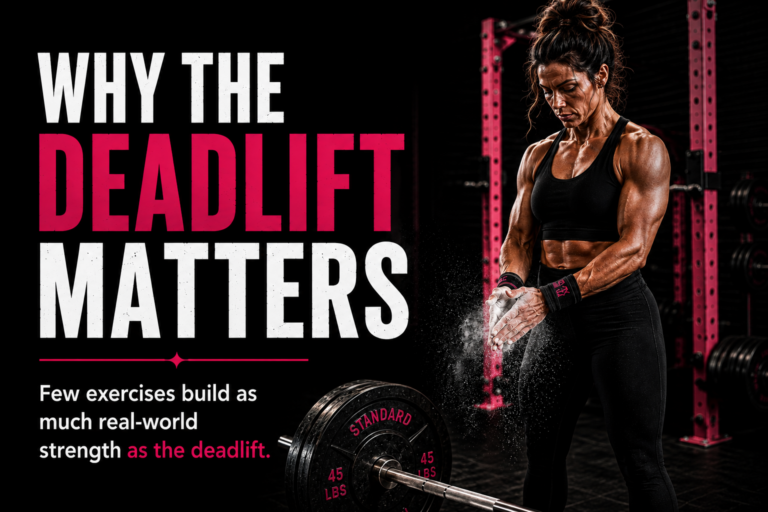
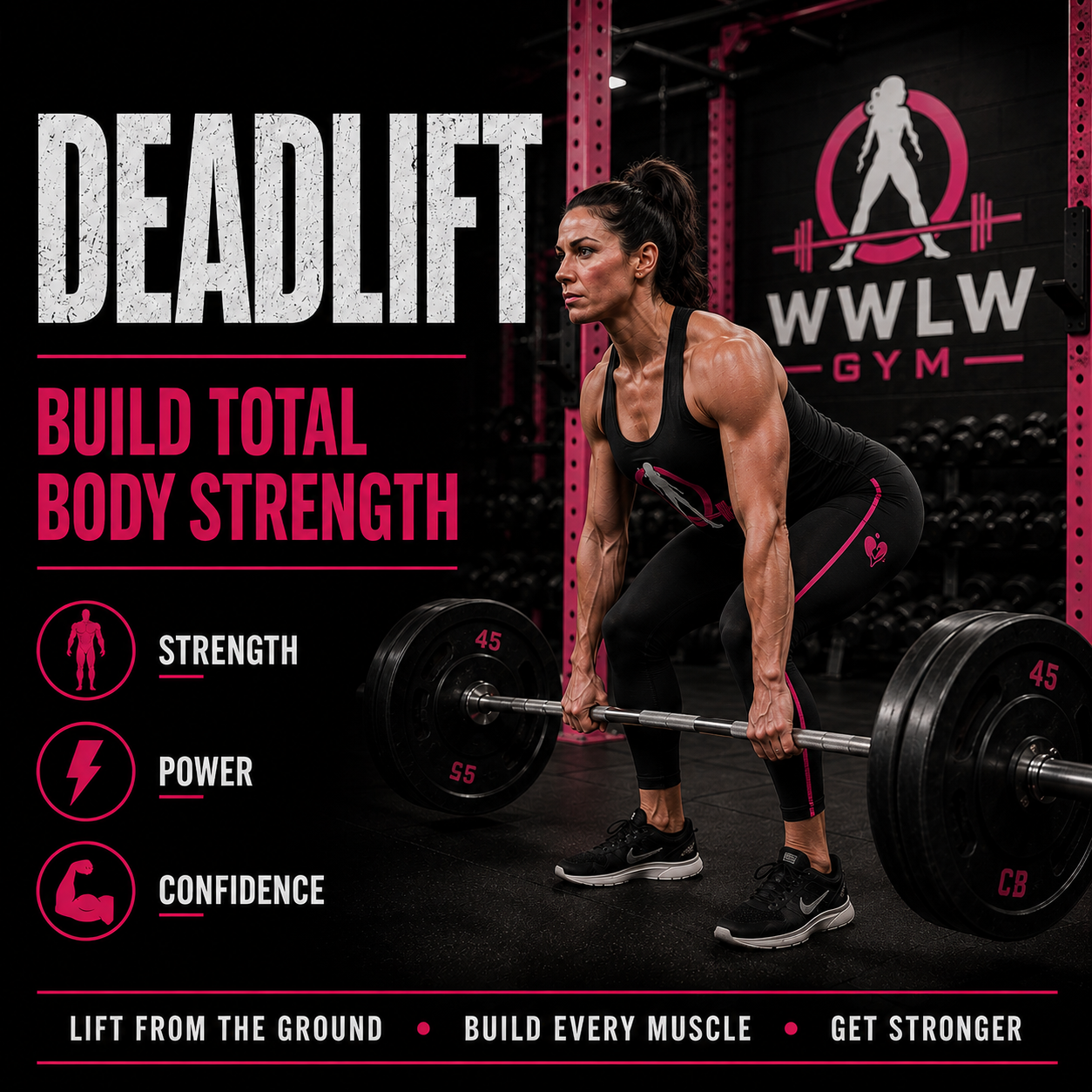
If the squat is king, the deadlift is the exercise that proves you can pick something heavy up off the ground — because that’s exactly what it trains. It’s one of the best total-body exercises for developing real strength, power, and confidence, starting from a dead stop on the floor.
There’s a reason the deadlift carries so much weight in strength training culture — literally and figuratively. It doesn’t isolate anything. Your legs, hips, back, and grip all have to work together to move the bar from the floor to lockout.
What Muscles Does the Deadlift Work?
The Barbell Deadlift is a total-body pulling movement that primarily targets your:
- Hamstrings
- Glutes
- Lower & upper back
- Core
- Grip & forearms
Because the bar starts on the floor, your entire posterior chain has to fire together to generate force from a dead stop. That’s what makes the deadlift such a complete strength builder — there’s no momentum to rely on, just raw, coordinated power.
How to Perform the Deadlift
- Stand with your feet hip-width apart, the bar over your mid-foot.
- Hinge at your hips and bend your knees to grip the bar just outside your legs.
- Brace your core, flatten your back, and pull the slack out of the bar.
- Drive through your feet, extending your hips and knees together to stand up with the bar.
- Keep the bar close to your body throughout the entire pull.
- Lock out at the top with your hips fully extended, then reverse the movement with control to lower the bar back down.
- Repeat for the desired number of repetitions.
Common Mistakes
- Rounding the lower back at the start of the pull.
- Letting the bar drift away from the body.
- Yanking the bar off the floor instead of pulling the slack out first.
- Hyperextending the lower back at the top of the lift.
- Starting with the hips too high or too low.
Coach Rob’s Tip
Before you pull, take the slack out of the bar. Get tight, get your back flat, and feel tension through the bar before it ever leaves the floor. If you’re yanking the bar up from a completely loose position, you’re setting yourself up for a rounded back and a missed lift. Set the tension first — then pull.
Watch the Exercise Demonstration
Watch the complete Barbell Deadlift demonstration below to see proper technique, body positioning, and coaching cues.
Barbell Row
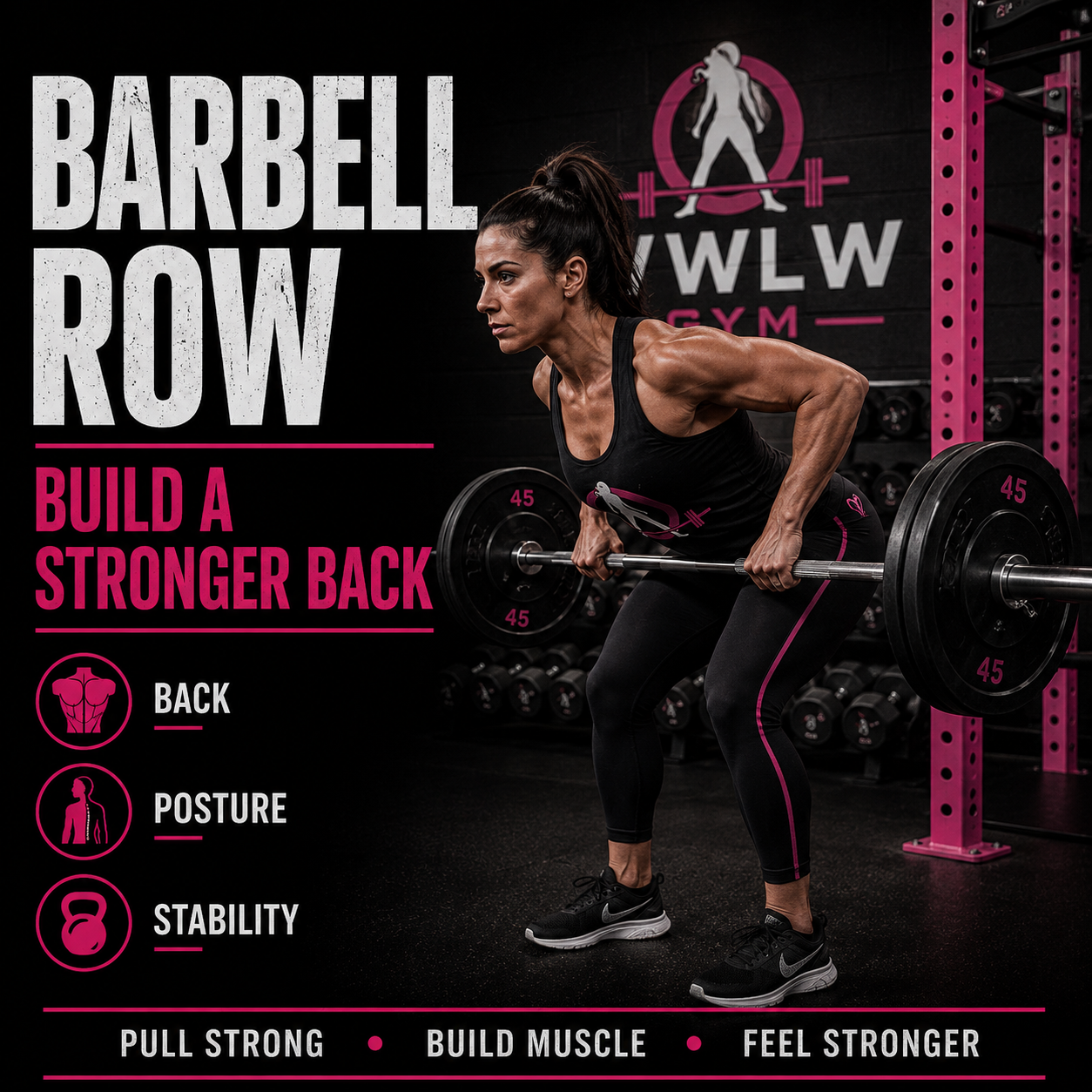
Every pressing movement needs a pulling movement to balance it out, and the Barbell Row is one of the best ways to build a stronger back with a single barbell. It also happens to be one of the most overlooked exercises on this list — most women spend far more time pressing than they do pulling.
That imbalance catches up with you eventually, usually as poor posture or nagging shoulder discomfort. The row directly counteracts it, strengthening the muscles that pull your shoulders back and keep you upright.
What Muscles Does the Barbell Row Work?
The Barbell Row is a horizontal pulling movement that primarily targets your:
- Back (lats, rhomboids, mid-back)
- Rear delts
- Biceps
- Core (stabilization)
Because you’re holding a hinged position while pulling the bar to your torso, your core and lower back have to stay braced and stable through every rep. That’s why the row builds posture and stability just as much as it builds a stronger back.
How to Perform the Barbell Row
- Stand with your feet shoulder-width apart, gripping the bar just outside your legs.
- Hinge at your hips until your torso is roughly parallel to the floor, with a slight bend in your knees.
- Brace your core and keep your spine neutral throughout the movement.
- Pull the bar up toward your lower ribs, leading with your elbows.
- Squeeze your shoulder blades together at the top of the row.
- Lower the bar back down with control until your arms are fully extended.
- Repeat for the desired number of repetitions.
Common Mistakes
- Rounding the lower back instead of hinging with a flat spine.
- Using body momentum to heave the bar up.
- Standing too upright instead of maintaining the hinge position.
- Not fully extending the arms at the bottom of each rep.
- Shrugging the shoulders up instead of pulling with the back.
Coach Rob’s Tip
Keep your torso still and let your arms do the moving. If your hips are bouncing or your back is rounding every time you pull the bar up, that’s momentum doing the work your back should be doing. Slow the rep down, hold your hinge, and lead with your elbows — a controlled row with a lighter bar builds more back strength than a heavy one done with a swing.
Watch the Exercise Demonstration
Watch the complete Barbell Row demonstration below to see proper technique, body positioning, and coaching cues.
Overhead Press
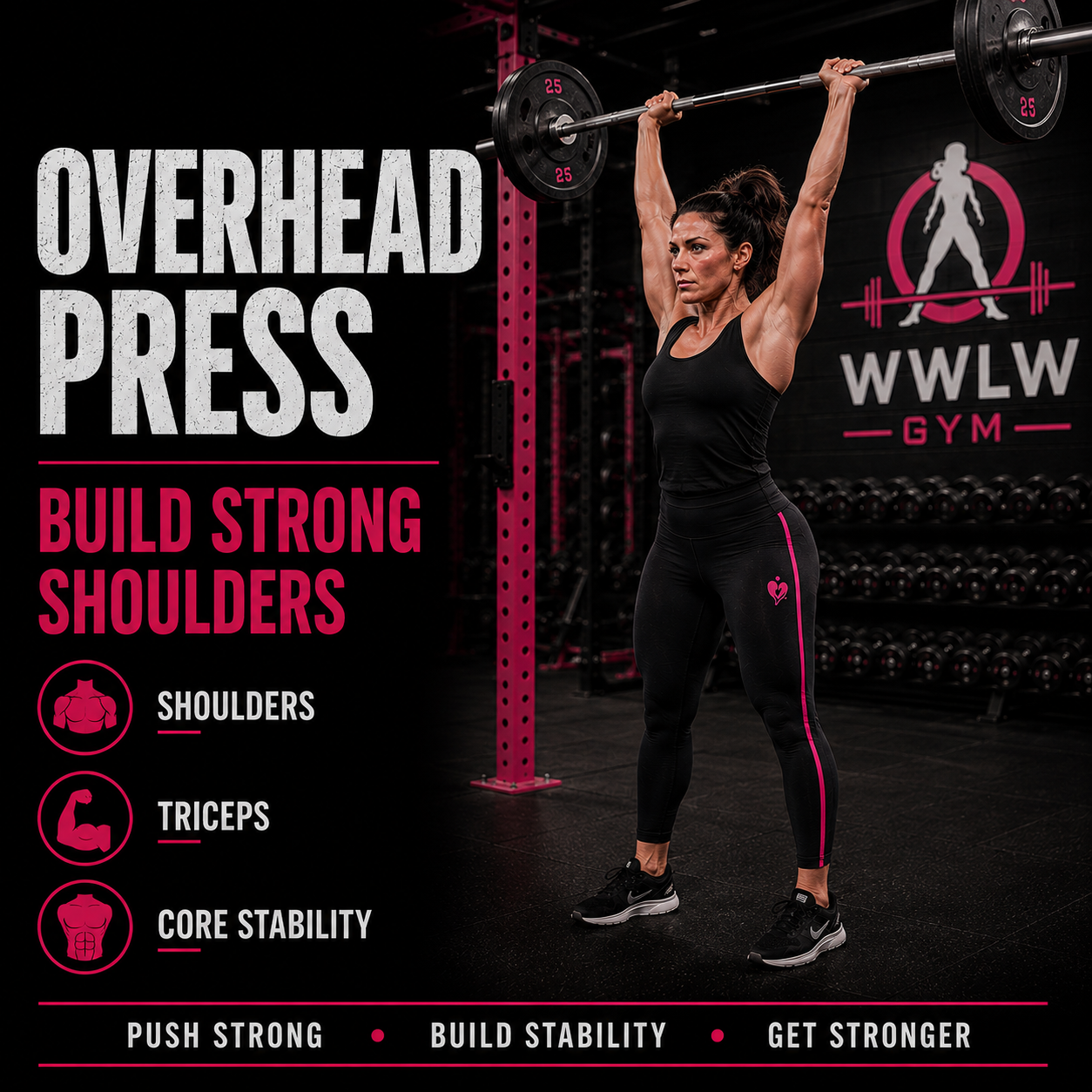
Rounding out the Big 5 is the Overhead Press — the one movement on this list that trains real standing pressing strength. No bench, no back support, just you and the bar fighting gravity straight overhead.
It’s also one of the best tests of total-body control you’ll find. Pressing a loaded barbell overhead from a standing position demands your core, glutes, and shoulders all work together to keep you stable — which is exactly why it belongs in a well-rounded strength program.
What Muscles Does the Overhead Press Work?
The Overhead Press is a standing compound push that primarily targets your:
- Shoulders
- Triceps
- Core stability
Because you’re pressing overhead with no back support, your core has to brace hard just to keep your torso upright and stable. That’s what makes the Overhead Press so much more than a shoulder exercise — it’s a full-body strength and stability builder disguised as an upper-body press.
How to Perform the Overhead Press
- Set the bar at roughly shoulder height and grip it just outside shoulder-width.
- Stand with your feet hip-width apart and brace your core.
- Rest the bar on your front shoulders, elbows slightly in front of the bar.
- Squeeze your glutes to keep your ribs stacked over your hips.
- Press the bar straight overhead, moving your head slightly back to let the bar pass, then through to lockout.
- Lower the bar back to your shoulders with control.
- Repeat for the desired number of repetitions.
Common Mistakes
- Arching the lower back to push the weight up.
- Pressing the bar forward instead of straight overhead.
- Flaring the ribs and losing core brace at the top.
- Using leg drive to “cheat” the weight up.
- Choosing a weight so heavy that form breaks down.
Coach Rob’s Tip
Watch your ribcage before you worry about the weight on the bar. If your ribs are flaring up and your lower back is arching as you press, your core has lost the brace — and that’s where overhead pressing goes wrong for most women. Keep your ribs stacked over your hips like you’re bracing for a punch to the stomach, and the strength will follow.
Watch the Exercise Demonstration
Watch the complete Overhead Press demonstration below to see proper technique, body positioning, and coaching cues.
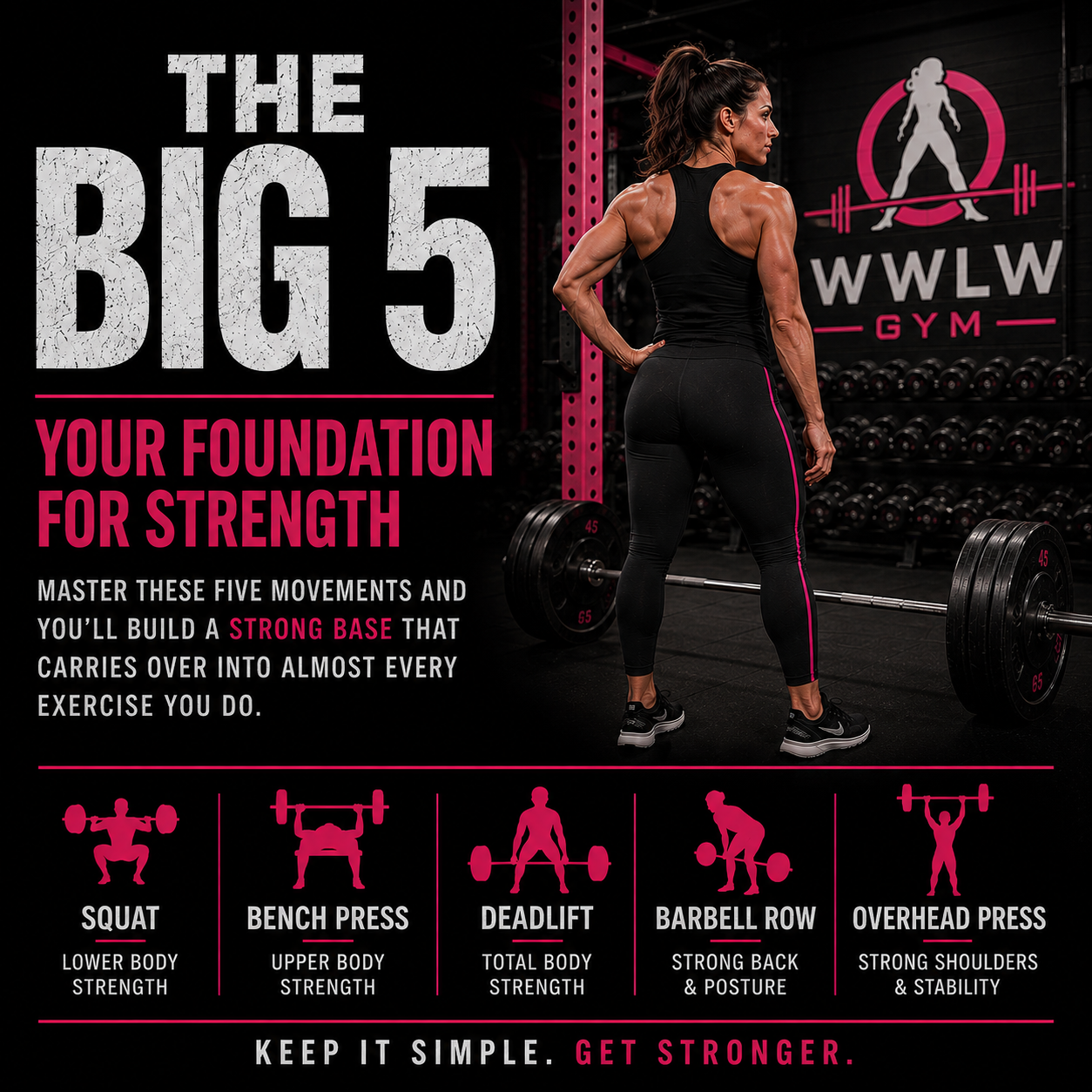
The Big 5: Your Foundation For Strength
Master these five movements and you’ll build a strong base that carries over into almost every exercise you do — in the gym and in everyday life.
That’s the whole list. Five movements, no complicated splits, no chasing variety for the sake of variety. Learn these properly, add weight over time, and stay consistent — everything else you build in the gym stands on top of this foundation.