Not Every Exercise Should Be Taken To Failure
If you’ve spent any time around strength training, you’ve probably heard some version of the same advice: train to failure to get results. Push every set until you physically cannot complete another rep, and the growth will follow.
Here’s the problem — that advice is true, but only in certain situations. Treated as a blanket rule for every single exercise in your workout, it’s not just incomplete, it can actually work against you.
Training close to failure absolutely has its place. It’s one of the most effective tools we have for building muscle. But not every exercise in your program is trying to accomplish the same thing — which means not every exercise should be pushed the same way.
The real skill isn’t knowing how to grind out a hard set. It’s knowing which sets deserve that grind, and which ones don’t. That distinction comes down to one simple question you should be asking yourself every time you step up to a movement:
Am I training the lift — or am I training the muscle?
Those two things are not the same, they don’t carry the same risk, and they don’t respond to intensity the same way. Once you understand the difference, you’ll stop guessing about how hard to push, and you’ll start training with an actual plan — one rep at a time.
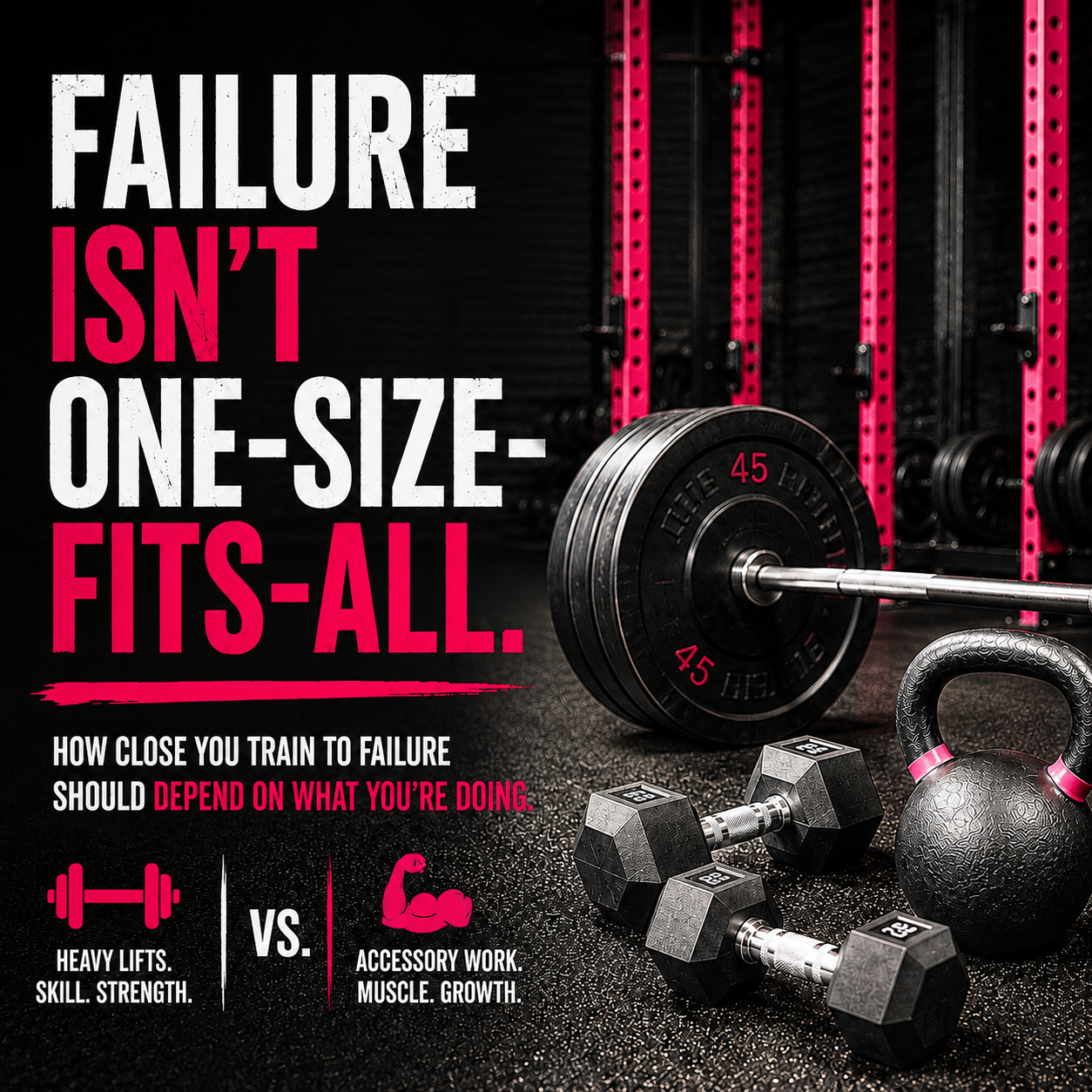
Failure Isn’t One-Size-Fits-All
Before we break down exactly how to apply this in your own training, it helps to understand why “just push to failure every time” doesn’t hold up.
Failure isn’t a single concept that applies the same way across every movement. How close you train to failure should depend entirely on what you’re doing — the exercise itself, the joints involved, the skill required, and what that exercise is actually meant to accomplish in your program.
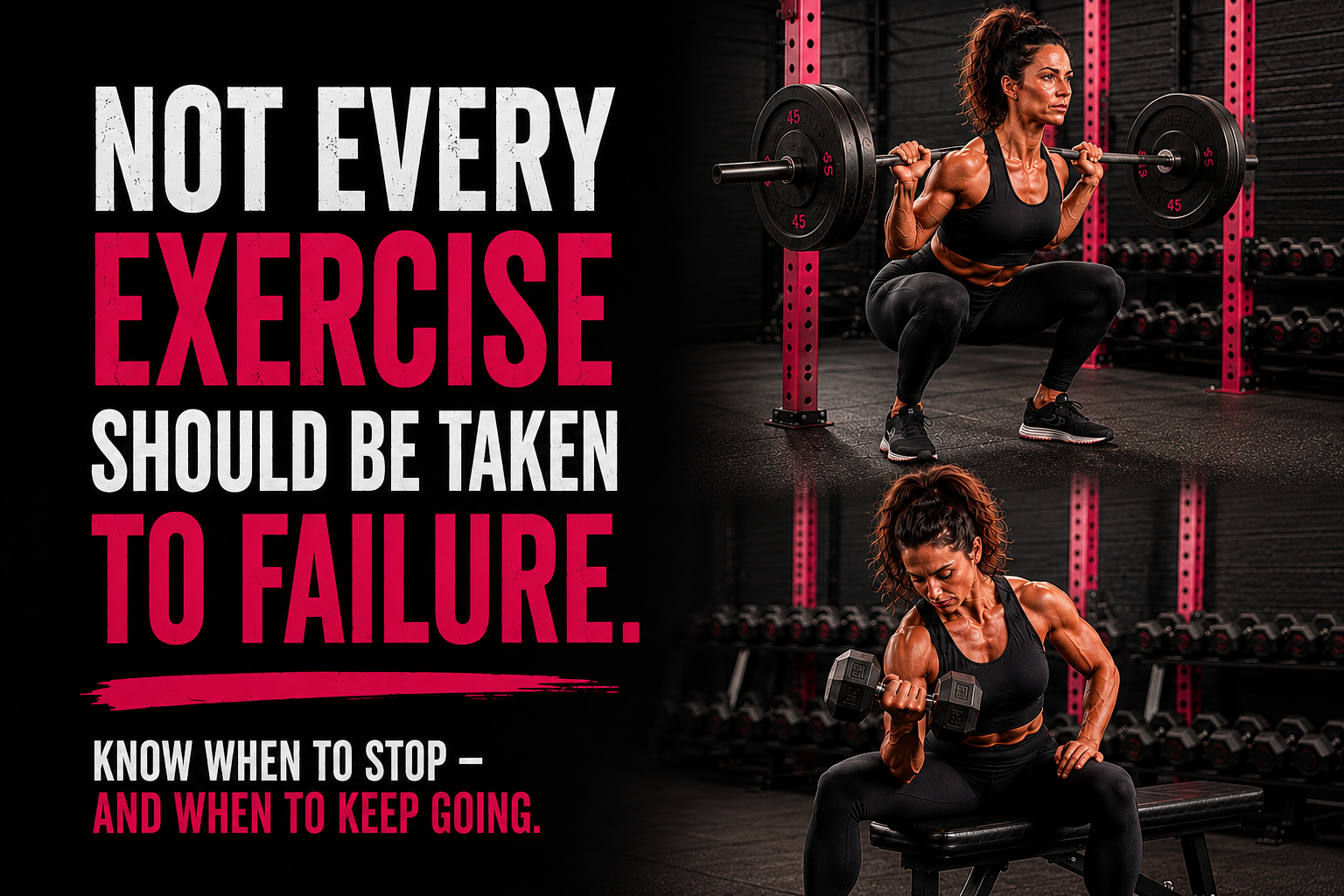
Think about the difference between a heavy barbell squat and a set of dumbbell lateral raises. On the surface, they’re both “exercises.” But they ask completely different things of your body.
A squat is a heavy, technical, multi-joint lift. It demands strength, coordination, and control through your hips, knees, ankles, and spine, all while you’re under load. A lateral raise is a single-joint, muscle-focused movement. It isolates the shoulder, carries very little technical risk, and its entire job is to fatigue one muscle group.
Pushing both of those movements to the exact same level of failure makes no sense once you actually think it through. One carries real risk when your form breaks down under fatigue. The other doesn’t — worst case, a lateral raise that falls apart at the end of a set just means the rep gets a little sloppy, not that you’re in danger of getting hurt.
This is the piece that gets lost in a lot of generic training advice. “Train to failure” gets repeated as a universal rule, without ever asking the follow-up question: failure on what, exactly?
Once you start separating your training into two categories — heavy lifts that require skill and strength, versus accessory work built for muscle and growth — the whole “how hard should I push” question gets a lot easier to answer. That’s exactly what we’re going to walk through next.

Gear Up For Your Next Workout
Programs, clothing, merchandise, and more — the WWLW Store has everything you need to train hard and represent the community that’s building strength together.
Shop The Store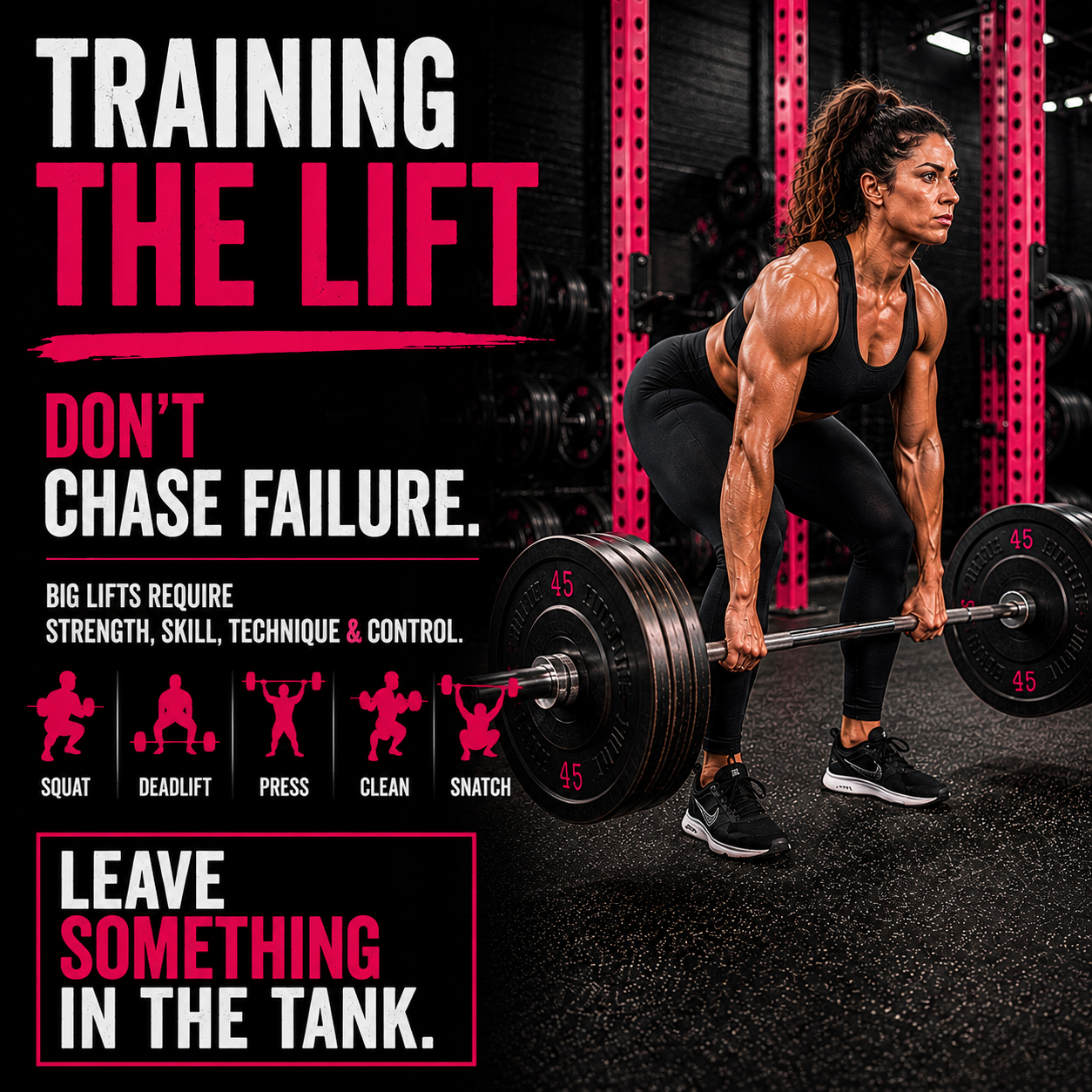
Training The Lift
Squats. Deadlifts. Presses. Cleans. Snatches.
These are your primary compound lifts — the big, multi-joint movements that form the foundation of a strength program. They’re not just exercises. They’re skills. Every rep asks your body to coordinate multiple muscle groups, joints, and stabilizers at the same time, all while moving a heavy external load through space.
That combination — heavy load plus technical demand — is exactly why these are not the lifts you should be chasing failure on.
When you push a technical lift too close to the edge, form is usually the first thing to go. Your bar path drifts. Your spine rounds. Your knees cave. You start compensating with momentum instead of strength. And because these lifts involve heavy external load, a technical breakdown here carries real consequences — the kind that can set your training back, not move it forward.
This doesn’t mean these lifts should be easy. Far from it. Training your lifts hard is exactly how you get stronger. It means:
- Push the weight and challenge yourself set after set.
- Progress your loads over time as strength and skill improve.
- Finish the majority of your working sets with a rep or two still left in the tank.
- Prioritize clean technique over grinding out one more ugly rep.
A hard set on a compound lift should feel demanding. Your last rep should be genuinely difficult. But it shouldn’t be the rep where your form falls apart and you’re fighting the bar just to finish. That’s the difference between training the lift and turning the lift into a grinder — and grinding out reps on a squat, deadlift, or press doesn’t build you up the way people think it does. Often, it just adds fatigue and risk without adding much benefit.
Don’t chase failure. Leave something in the tank.
Training The Muscle
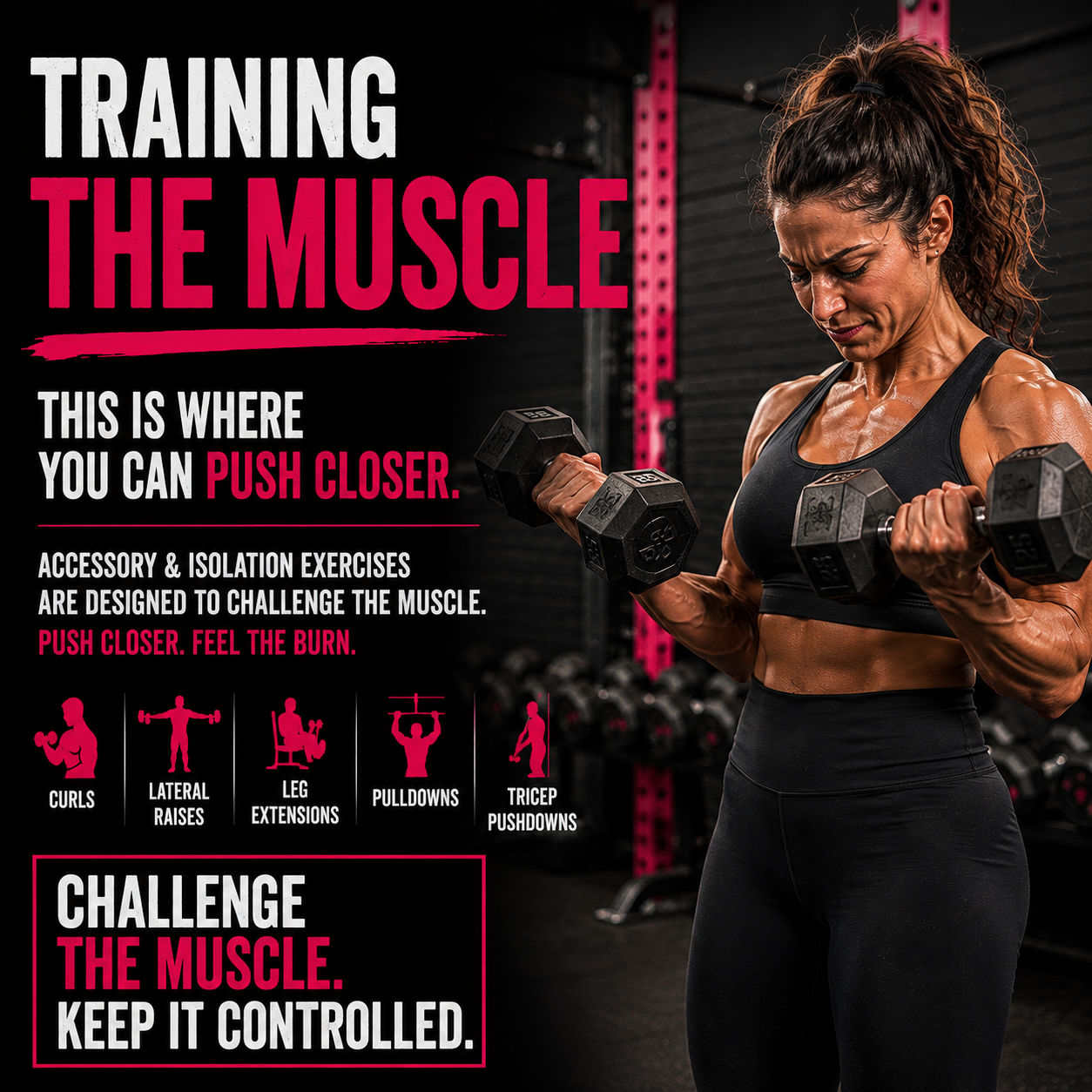
Curls. Lateral raises. Leg extensions. Pulldowns. Tricep pushdowns.
This is a completely different category of exercise — and it comes with a completely different set of rules. These are your accessory and isolation movements. Instead of coordinating multiple joints and muscle groups to move a heavy load, they’re built to do one thing: put direct, focused tension on a single muscle.
Because the technical demand is so much lower, the risk profile changes completely. There’s no complex bar path to protect, no heavy external load traveling through multiple joints, no skill component that breaks down under fatigue. A curl is a curl. A leg extension is a leg extension. The range of motion is fixed, the movement pattern is simple, and the muscle you’re targeting is doing almost all of the work.
That’s exactly why this is the category where you can — and should — push closer to failure.
This is where you:
- Make the last few reps genuinely challenging, not just “a little tired.”
- Push close to true muscular failure on a regular basis.
- On the right exercises, don’t be afraid to occasionally take a set all the way there.
- Focus on feeling the muscle work — chase the burn, chase the pump, chase the tension.
Here’s the important part, though: pushing closer to failure doesn’t mean abandoning control. The goal isn’t to throw the weight around just to grind out extra reps — it’s to keep the movement controlled while you challenge the muscle as hard as you can within that controlled range. A sloppy curl with momentum isn’t training the bicep harder, it’s just training it less directly. Keep the technique clean, keep the tension on the muscle, and let the intensity come from effort, not from cheating the rep.
Challenge the muscle. Keep it controlled.
Putting The Pieces Together
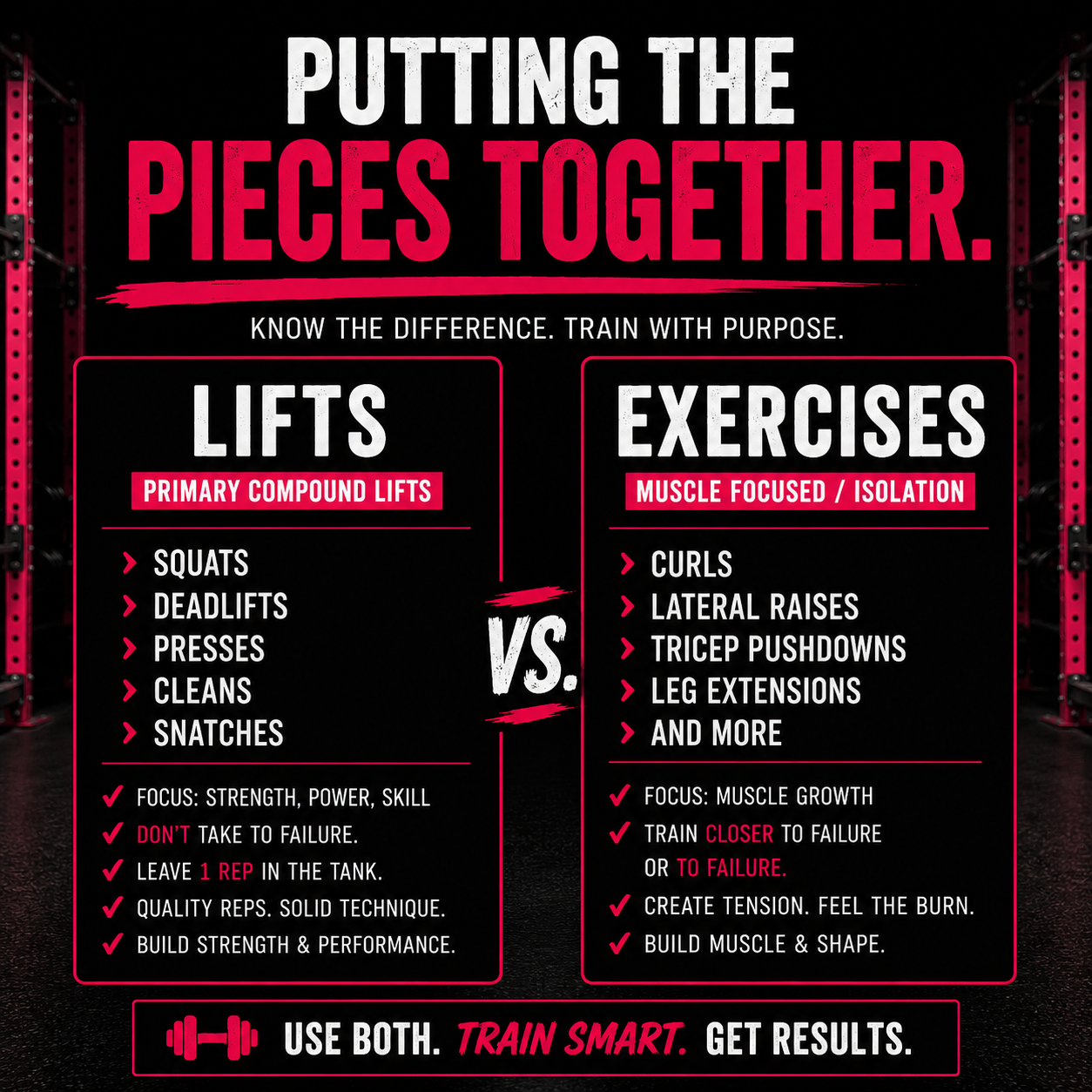
Know the difference. Train with purpose.
Once you can quickly sort any exercise into one of these two buckets, deciding how hard to push stops being a guessing game. Here’s the full breakdown side by side:
Lifts
- Squats
- Deadlifts
- Presses
- Cleans
- Snatches
- Focus: strength, power, skill
- Don’t take to failure
- Leave a few rep in the tank
- Quality reps. Solid technique.
- Build strength & performance
Exercises
- Curls
- Lateral raises
- Tricep pushdowns
- Leg extensions
- And more
- Focus: muscle growth
- Train closer to failure or to failure
- Create tension. Feel the burn.
- Build muscle & shape
Neither column is “better” than the other — they’re not competing with each other, they’re working together. Your lifts are what make you stronger and more capable. Your accessory work is what shapes, builds, and finishes the muscle those lifts are built on. You need both pieces to get the full picture.
Use both. Train smart. Get results.
Train With Purpose
So where does that leave you? Not with a single rule to follow blindly, but with a better question to ask yourself every time you load a bar or pick up a dumbbell.
You don’t need to take everything to failure to get results. And you don’t need to avoid failure completely, either. Both of those extremes miss the point. The women who make the most consistent progress aren’t the ones grinding every single set into the ground — and they’re not the ones playing it so safe that nothing ever gets truly challenged. They’re the ones who understand what each exercise is actually for, and they train it accordingly.
That’s the real skill here. Not intensity for intensity’s sake, but intensity applied with intention. Your squats, deadlifts, and presses are building the strength and skill that everything else is built on — protect that foundation by leaving something in the tank. Your curls, raises, and pushdowns are there to challenge and shape the muscle — so let yourself push into that discomfort and get the full benefit of the work.
The next time you’re standing over a bar or holding a pair of dumbbells, ask yourself: am I training the lift, or am I training the muscle? Let the answer decide how hard you push.
Know what you’re training. Know why you’re training it.
Then train it with purpose.